
Mapping the 1857 Revolt: Complete Visual Guide to Major Centers and Spread | Class 8 History Chapter 5
Introduction
The revolt of 1857, also known as the First War of Independence, was a watershed moment in Indian history. While understanding the causes and consequences of this uprising is crucial, visualizing its geographical spread through maps provides students with a deeper comprehension of how the rebellion unfolded across different regions of India.
For Class 8 CBSE History students, mapping the 1857 revolt is not just an academic exercise—it’s a skill that helps you understand the strategic importance of different locations, the role of prominent leaders, and the chronological progression of events. This visual guide will take you through each major center of the revolt, explaining why these locations mattered and how they connect to form the complete picture of India’s first organized resistance against British colonial rule.

In board examinations, map-based questions on the 1857 revolt typically carry 5 marks and require you to accurately mark major centers, label them with dates and leaders, and demonstrate your understanding of the revolt’s geographical spread. This comprehensive guide will not only help you master the content but also provide you with practical strategies for answering such questions effectively in your exams.
🎯 Why This Topic Matters
📝 Exam Relevance: This topic frequently appears in CBSE board exams as a 5-mark map question. Students are often asked to mark major centers of the 1857 revolt, label them with leaders’ names, and show the geographical spread with arrows or symbols. According to recent exam patterns, map-based questions on the 1857 revolt have appeared in 8 out of the last 10 years’ question papers.

🧠 Conceptual Importance: Understanding the geographical spread of the revolt helps you grasp why certain regions participated while others remained quiet, the strategic significance of locations like Delhi and Meerut, and how the British were able to suppress the revolt by isolating affected regions. This builds critical thinking skills about the relationship between geography and historical events.
📊 Board Exam Frequency: Very High – Map questions on the 1857 revolt are among the most predictable questions in Class 8 History. Mastering this topic virtually guarantees 5 marks in your exam.
🎨 Skills Developed: Map-reading, spatial understanding, connecting leaders to locations, chronological thinking, and visual presentation—all valuable skills for higher classes and competitive exams.
🗺️ Complete Visual Guide: Mapping the 1857 Revolt


📚 Topic Overview: This comprehensive guide will help you master the geographical mapping of the 1857 revolt, covering all major centers, leaders, and the chronological spread of the uprising across North-Central India.
📸 Image Insertion Instructions:
- Upload
page_001.jpgto WordPress Media Library - Copy the image URL from Media Library
- Replace
UPLOAD_IMAGE_HEREabove with the copied URL - Verify the image displays correctly in preview
Why We Map the Revolt: Understanding the Purpose
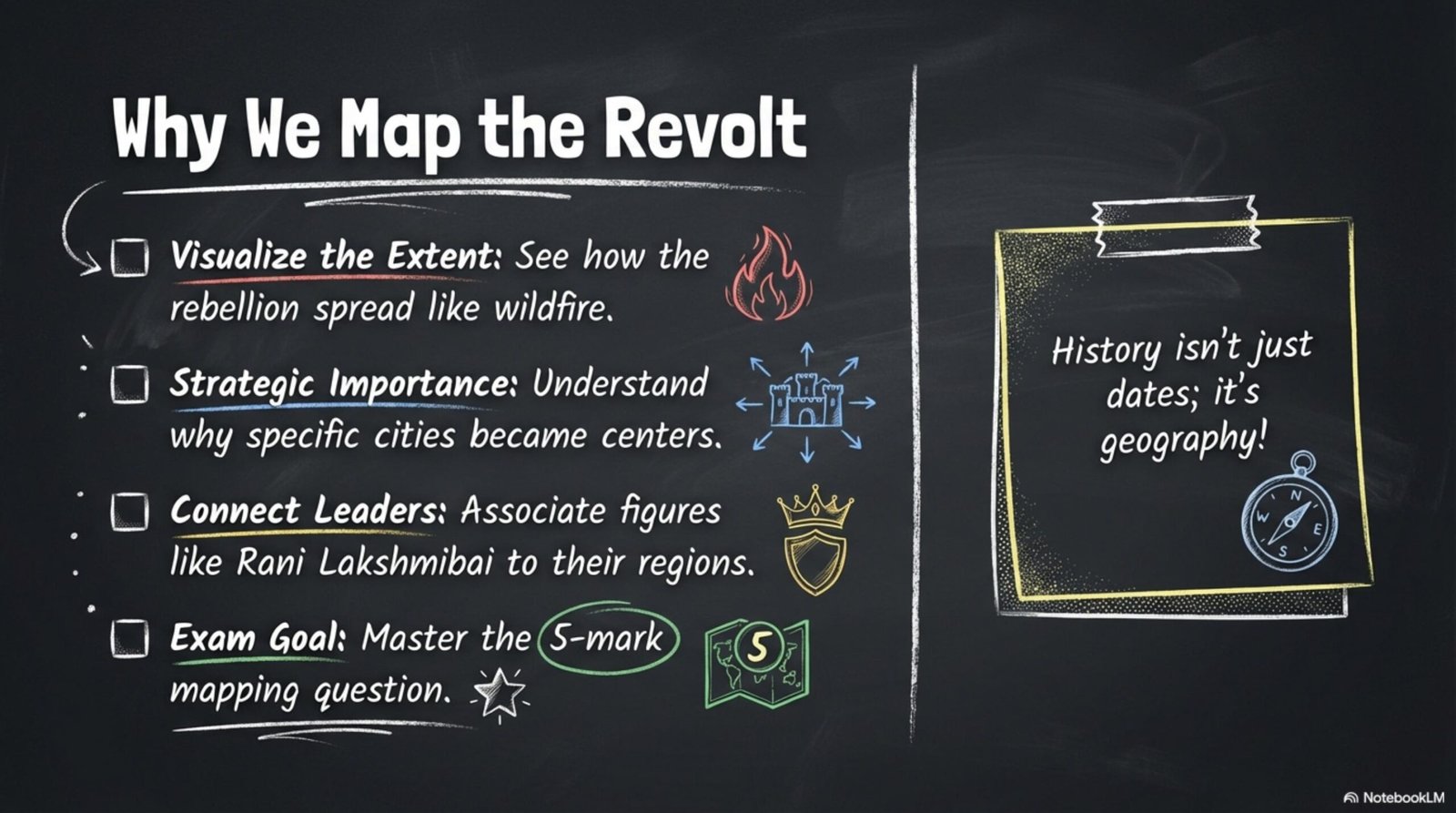
🎯 Purpose of Mapping: This visual explains the four key reasons why mapping the revolt is essential—visualizing the extent, understanding strategic importance, connecting leaders to regions, and mastering the 5-mark exam question format.
📸 Image Insertion Instructions:
- Upload
page_002.jpgto WordPress Media Library - Copy the image URL from Media Library
- Replace
UPLOAD_IMAGE_HEREabove with the copied URL - Verify the image displays correctly in preview
Before diving into the specific locations, it’s important to understand why we create maps of historical events like the 1857 revolt. Mapping serves multiple educational purposes:
1. Visualize the Extent: A map immediately shows you how the rebellion spread like wildfire across North and Central India. Instead of just reading about different locations, you can see the geographical pattern—how the revolt started at one point (Meerut) and radiated outward to major cities.
2. Strategic Importance: Not all cities were equal in this revolt. By mapping them, you understand why specific cities became centers of resistance. For example, Delhi’s symbolic importance as the Mughal capital, Kanpur’s strategic location on the Ganges, or Lucknow’s status as the capital of Awadh all become clearer when you see their positions on a map.
3. Connect Leaders to Regions: Maps help you associate prominent figures like Rani Lakshmibai with Jhansi, Nana Sahib with Kanpur, and Begum Hazrat Mahal with Lucknow. This geographical-biographical connection makes it much easier to remember who led the revolt where.
4. Exam Goal: Most importantly for Class 8 students, mastering the 5-mark mapping question is one of the easiest ways to secure full marks in your board exam. Unlike essay questions where answers can vary, map questions have definite right answers—mark the correct locations, label them properly, and you get full marks!
💡 Study Tip:
History is not just about memorizing dates—it’s about understanding people and places. When you connect events to specific geographical locations, your brain creates stronger memory associations. This is why map-based learning is so effective!
Step 1: Preparing Your Canvas – Understanding the North-Central Belt
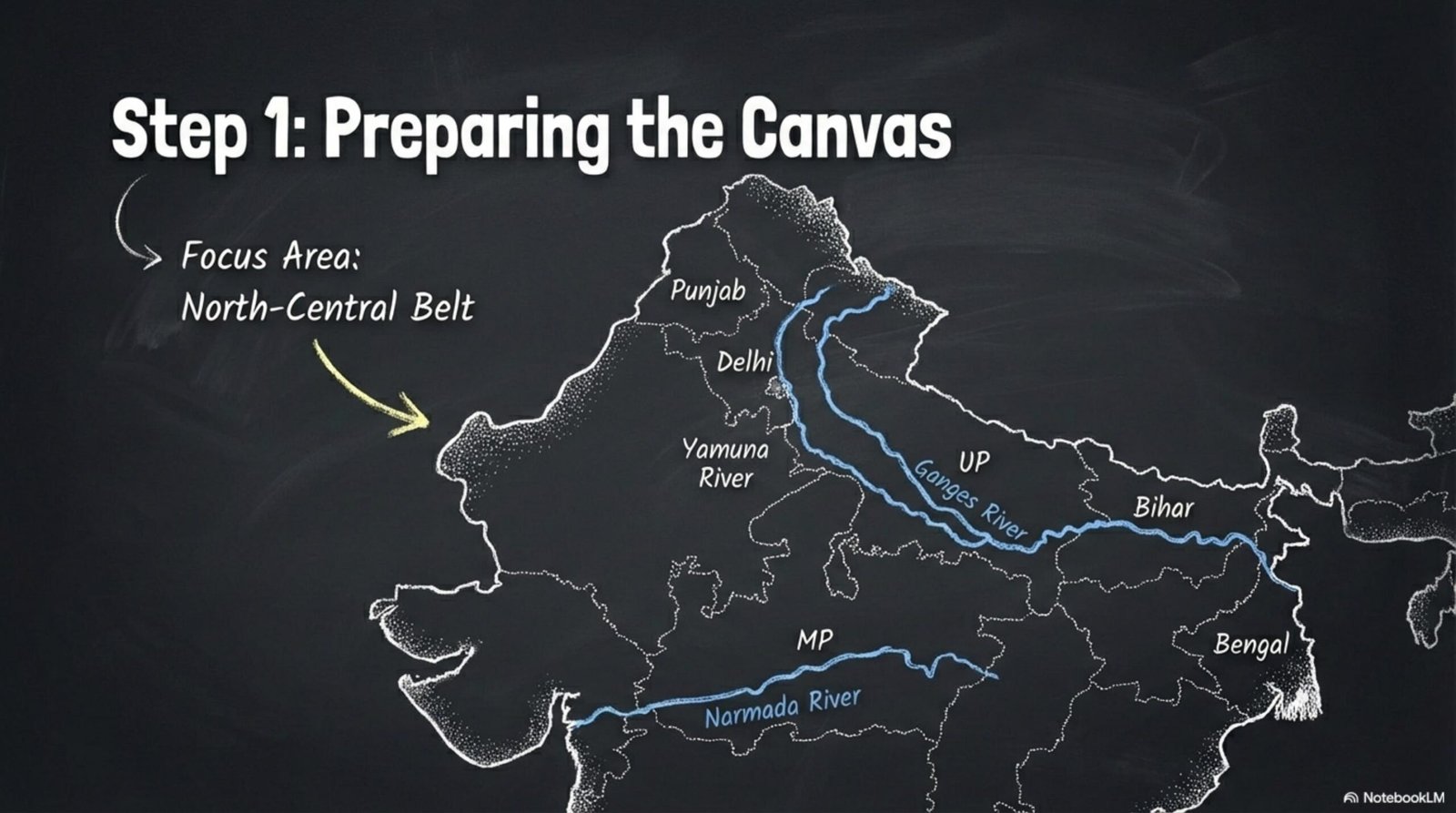
🗺️ The Canvas: This map shows the North-Central Belt of India, including Punjab, Delhi, Uttar Pradesh, Madhya Pradesh, and Bihar—the primary theatre of the 1857 revolt. Major rivers like Yamuna, Ganges, and Narmada are marked as geographical reference points.
📸 Image Insertion Instructions:
- Upload
page_003.jpgto WordPress Media Library - Copy the image URL from Media Library
- Replace
UPLOAD_IMAGE_HEREabove with the copied URL - Verify the image displays correctly in preview
When you begin drawing a map of the 1857 revolt in your exam, the first step is to sketch the basic geographical canvas. You don’t need to draw the entire Indian subcontinent in perfect detail—focus on the North-Central Belt, which was the primary region affected by the revolt.
Key Geographical Features to Include:
- Punjab – Northwestern region (upper left of your map)
- Delhi – Central position, the symbolic heart of the revolt
- Uttar Pradesh (UP) – Large state in the north-central region, home to most revolt centers
- Madhya Pradesh (MP) – Central India, including Jhansi and Gwalior
- Bihar – Eastern region, where the revolt spread later
Important Rivers to Mark:
- Yamuna River – Flows through Delhi, connecting it to the Ganges
- Ganges River – Major river running through UP and Bihar, along which many revolt centers were located
- Narmada River – Southern boundary, marking the limit of the revolt’s spread
These rivers are important because they served as natural corridors for communication and troop movement during the revolt. Many major cities were located along these river valleys, making them strategically significant.
⚠️ Common Mistake to Avoid:
Don’t waste exam time trying to draw perfect state boundaries or river courses. Rough, recognizable outlines are sufficient. Examiners are looking for accurate placement of revolt centers, not artistic perfection!
The Spark: Meerut (May 10, 1857)
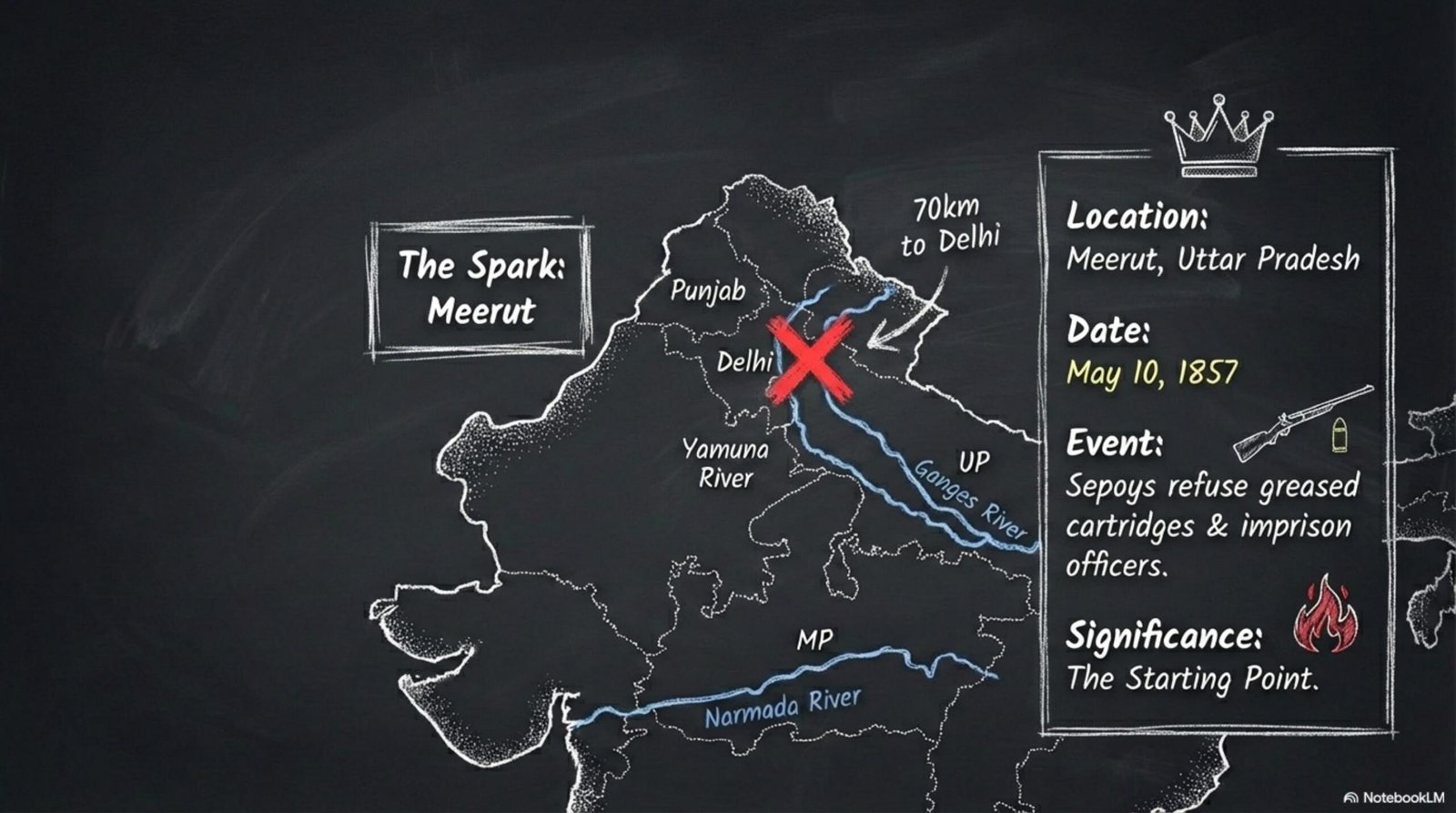
⚡ The Spark at Meerut (May 10, 1857): This map highlights Meerut in Uttar Pradesh, approximately 70km northeast of Delhi, marked with a red X and explosion symbol, indicating where the revolt began when sepoys refused to use greased cartridges and imprisoned British officers.
📸 Image Insertion Instructions:
- Upload
page_004.jpgto WordPress Media Library - Copy the image URL from Media Library
- Replace
UPLOAD_IMAGE_HEREabove with the copied URL - Verify the image displays correctly in preview
Every great historical event has a starting point, and for the 1857 revolt, that point was Meerut. Located in present-day Uttar Pradesh, approximately 70 kilometers northeast of Delhi, Meerut holds the distinction of being where the first organized military rebellion against the British began.
What Happened at Meerut?
On May 10, 1857, a group of Indian sepoys (soldiers in the British East India Company’s army) stationed at the Meerut cantonment took a stand that would change the course of Indian history. The immediate trigger was the introduction of new Enfield rifles, which required soldiers to bite off the ends of cartridges that were greased with animal fat—cow fat (offensive to Hindus) and pig fat (offensive to Muslims).
When 85 sepoys refused to use these cartridges on religious grounds, they were court-martialed, publicly humiliated, and sentenced to ten years of imprisonment. This harsh punishment sparked outrage among their fellow soldiers. On the evening of May 10, the sepoys rebelled, freed their imprisoned comrades, killed several British officers, and set fire to British properties in the cantonment.
Why Meerut Was Significant:
- Strategic Location: Meerut’s proximity to Delhi (just 70 km away) meant that rebels could quickly march to the symbolic capital and give their uprising political legitimacy
- Military Concentration: Meerut had one of the largest concentrations of Indian soldiers in British service, providing the manpower for rebellion
- Symbolic Importance: It represented the first organized military resistance, demonstrating that discontent had reached a breaking point
- Catalyst Effect: The success of the Meerut uprising inspired similar rebellions across North India within days
For Your Map: Always mark Meerut with a clear, distinct symbol (like a star ★ or explosion ⚡) and label it “Meerut – May 10, 1857” to show it as the chronological starting point. This immediately demonstrates to the examiner that you understand the sequence of events.
The Symbolic Capital: Delhi (May 11, 1857)
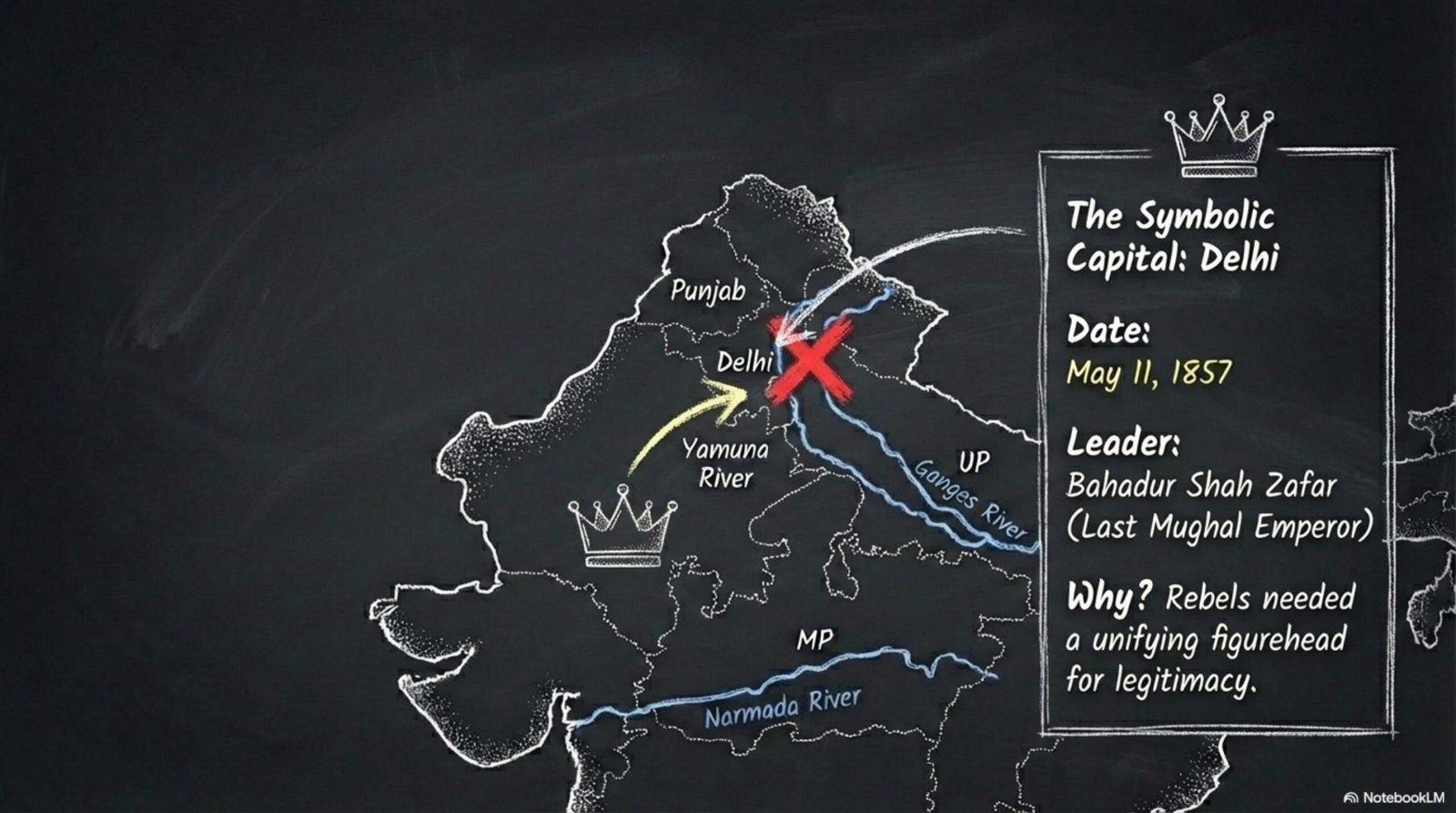
👑 The Symbolic Capital: Delhi (May 11, 1857): After rebelling at Meerut, sepoys marched to Delhi and proclaimed Bahadur Shah Zafar, the last Mughal emperor, as their leader. This gave the revolt political legitimacy and a unifying figurehead.
📸 Image Insertion Instructions:
- Upload
page_005.jpgto WordPress Media Library - Copy the image URL from Media Library
- Replace
UPLOAD_IMAGE_HEREabove with the copied URL - Verify the image displays correctly in preview
Within hours of the Meerut uprising, the rebels made a crucial strategic decision: they marched to Delhi. But why Delhi? The answer lies in understanding the symbolic power of this ancient city.
Delhi’s Historical Significance:
Delhi had been the seat of Mughal power for over two centuries. Though the Mughal Empire had declined significantly by 1857, the Mughal emperor still resided in the Red Fort, and Delhi remained a powerful symbol of Indian sovereignty in the collective consciousness. The rebels understood that their uprising needed more than military force—it needed legitimacy.
Bahadur Shah Zafar: The Reluctant Leader
On May 11, 1857, the day after the Meerut uprising, rebel soldiers reached Delhi and proclaimed Bahadur Shah Zafar, the 82-year-old last Mughal emperor, as their leader. Bahadur Shah Zafar was more of a poet than a warrior, and he was initially reluctant to join the revolt. However, the rebels needed a unifying figurehead—someone whose name commanded respect across different regions and communities.
By declaring allegiance to the Mughal emperor, the rebels transformed their uprising from a military mutiny into a broader political movement against British rule. This gave the revolt legitimacy in the eyes of many Indians who might otherwise have remained neutral.
Why Delhi Mattered:
- Symbolic Power: Delhi represented the idea of Indian sovereignty and pre-British rule
- Unifying Figure: Bahadur Shah Zafar’s name could rally diverse groups—Hindus, Muslims, soldiers, and civilians
- Strategic Location: Delhi’s central position made it an ideal headquarters for coordinating the revolt
- Psychological Impact: Capturing Delhi sent a powerful message that British authority could be challenged
💡 Exam Tip:
When marking Delhi on your map, always write “Delhi – Bahadur Shah Zafar” next to it. This shows you understand the connection between the location and its leader. Also, you can draw a crown symbol (👑) to indicate its status as the symbolic capital of the revolt.
The Difference Between Meerut and Delhi: It’s important to understand that Meerut and Delhi played different roles. Meerut was the spark—where the military rebellion began. Delhi was the symbol—where the rebellion gained political legitimacy. Together, they formed the foundation of the 1857 revolt.
The Fire Spreads: Awadh Region (Lucknow and Kanpur)
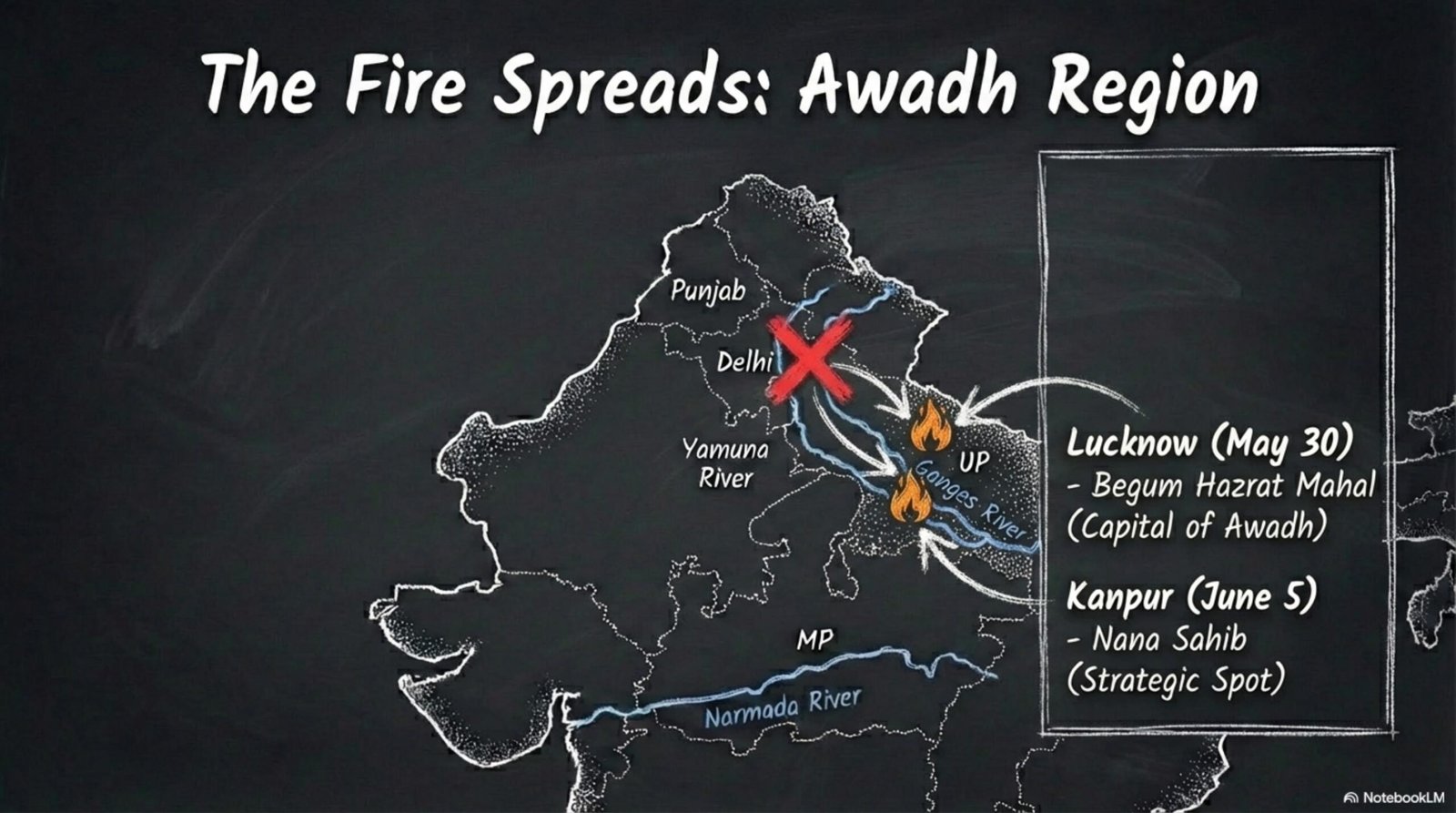
🔥 The Fire Spreads to Awadh Region: Within weeks, the revolt spread to the Awadh region. Lucknow (May 30) became a major center under Begum Hazrat Mahal, capital of Awadh, while Kanpur (June 5) emerged as a strategic military position under Nana Sahib.
📸 Image Insertion Instructions:
- Upload
page_006.jpgto WordPress Media Library - Copy the image URL from Media Library
- Replace
UPLOAD_IMAGE_HEREabove with the copied URL - Verify the image displays correctly in preview
Once Delhi fell to the rebels, the uprising spread rapidly along the Ganges River valley into the Awadh region (present-day central Uttar Pradesh). Two cities in this region became major centers of resistance: Lucknow and Kanpur.
Lucknow: The Capital of Awadh (May 30, 1857)
Lucknow was the capital of Awadh, a prosperous kingdom that the British had annexed just a year earlier in 1856 using the controversial Doctrine of Lapse. This recent annexation had created deep resentment among the people of Awadh—from the displaced nobility to common soldiers who had lost their livelihoods.
On May 30, 1857, the revolt reached Lucknow. The leadership fell to Begum Hazrat Mahal, the wife of the deposed Nawab of Awadh. She proved to be a capable military strategist and rallied both soldiers and civilians to the cause. Under her leadership, Lucknow became one of the most fiercely defended centers of the revolt, with rebels holding out against British forces for several months.
Kanpur: The Strategic Military Hub (June 5, 1857)
Located on the banks of the Ganges River, Kanpur (then called Cawnpore) was a major British military station and commercial center. Its strategic location made it a crucial point for controlling movement along the Ganges valley.
On June 5, 1857, Nana Sahib (Dhondu Pant), the adopted son of the last Peshwa Baji Rao II, led the revolt in Kanpur. Nana Sahib had his own grievances against the British, who had refused to recognize his claim to his adoptive father’s pension. Under his leadership, Kanpur became a major battlefield, with some of the most intense fighting of the entire revolt.
Why the Awadh Region Mattered:
- Recent Annexation: The 1856 annexation of Awadh had created widespread resentment, making the region ripe for rebellion
- Military Strength: Awadh had a large number of disbanded soldiers who joined the revolt
- Economic Importance: The region was prosperous, providing resources to sustain the rebellion
- Strategic Location: Control of the Ganges valley meant control of a major communication and trade route
- Popular Support: Unlike some other regions, the Awadh revolt had strong support from the local population, not just soldiers
📚 Historical Context:
The British annexation of Awadh in 1856 was particularly controversial. The Nawab of Awadh was accused of misgovernment, but many historians argue that the real reason was British desire to control this wealthy region. This annexation created such resentment that when the revolt began, Awadh became one of its strongest centers.
Central India’s Resistance: Jhansi and Gwalior
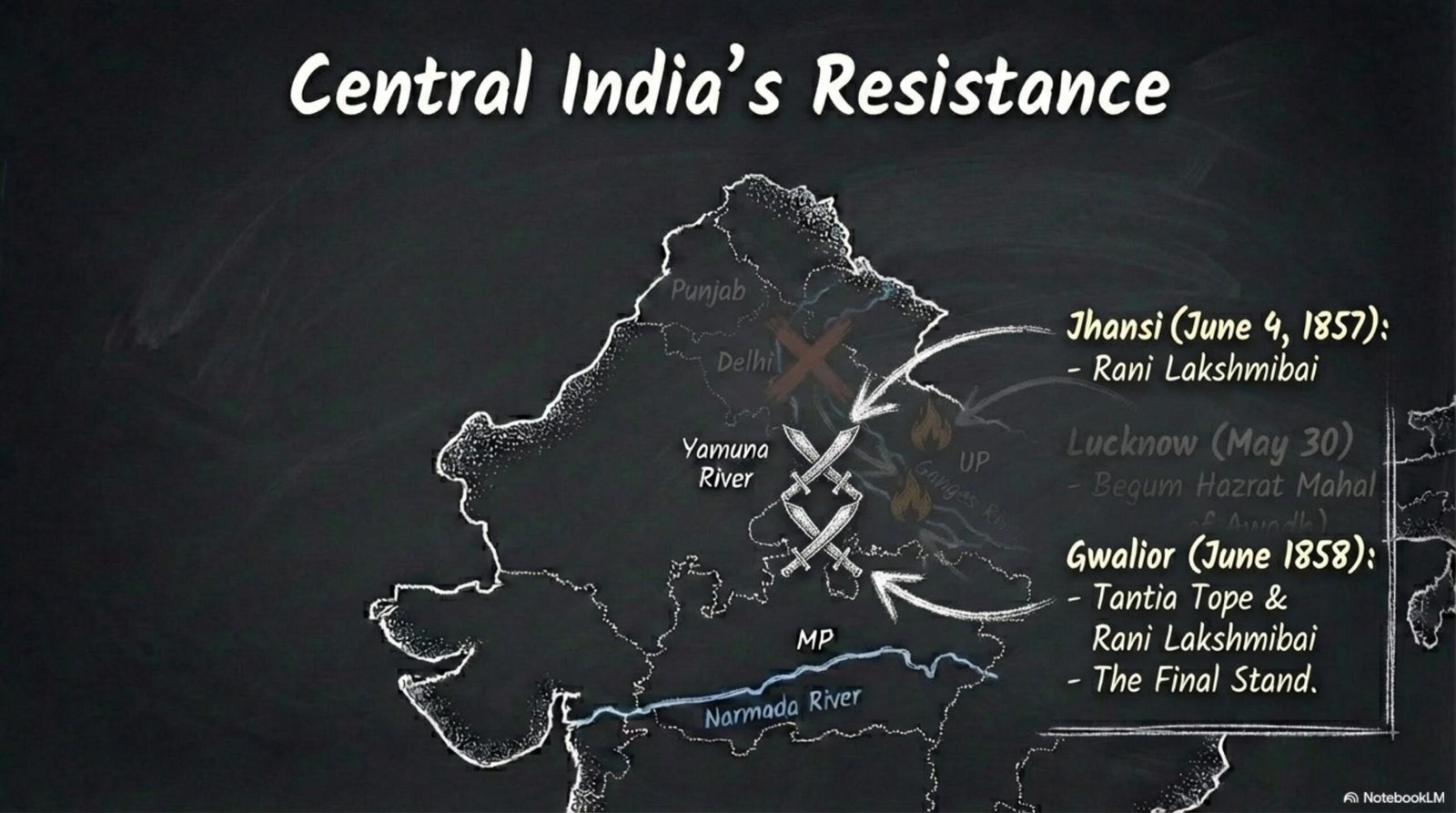
⚔️ Central India’s Resistance: Jhansi (June 4, 1857) under the legendary Rani Lakshmibai became a symbol of fierce resistance. The final stand occurred at Gwalior (June 1858) where Rani Lakshmibai and Tantia Tope made their last major battle.
📸 Image Insertion Instructions:
- Upload
page_007.jpgto WordPress Media Library - Copy the image URL from Media Library
- Replace
UPLOAD_IMAGE_HEREabove with the copied URL - Verify the image displays correctly in preview
As the revolt spread southward from the Ganges valley, it found strong support in Central India, particularly in the princely states of Jhansi and Gwalior. This region produced one of the most iconic figures of the entire uprising: Rani Lakshmibai of Jhansi.
Jhansi: The Warrior Queen’s Stand (June 4, 1857)
Rani Lakshmibai (born Manikarnika, nicknamed Manu) was the queen of the princely state of Jhansi. After her husband’s death in 1853, the British had refused to recognize her adopted son as the heir, annexing Jhansi under the Doctrine of Lapse. This personal grievance, combined with her sense of duty to her people, led her to join the revolt.
On June 4, 1857, when the revolt reached Jhansi, Rani Lakshmibai took charge of the city’s defense. She organized an army, trained women to fight, and personally led troops into battle. Her courage and military skills made her a legendary figure—British officers who fought against her later wrote with admiration about her bravery.
What makes Rani Lakshmibai particularly remarkable is that she fought not just as a symbolic leader but as an actual military commander. Accounts describe her riding into battle with her adopted son tied to her back, wielding a sword in each hand, and leading cavalry charges against British forces.
Gwalior: The Final Stand (June 1858)
After Jhansi fell to British forces in April 1858, Rani Lakshmibai escaped and joined forces with Tantia Tope, another prominent rebel leader. Together, they captured the fortress city of Gwalior in June 1858, making it the last major stronghold of the revolt.
On June 18, 1858, during the Battle of Gwalior, Rani Lakshmibai was killed in action while fighting British troops. She was only 29 years old. Her death marked the end of major organized resistance in Central India, though guerrilla warfare continued for several more months.
Why Jhansi and Gwalior Mattered:
- Strategic Fortresses: Both cities had strong fortifications, making them difficult for British forces to capture
- Symbolic Leadership: Rani Lakshmibai became a symbol of resistance, inspiring others across India
- Military Significance: Control of Central India was crucial for connecting different revolt centers
- Last Stand: Gwalior represented the final major battle of the organized revolt
- Legacy: Rani Lakshmibai’s courage continues to inspire Indians today, making Jhansi an important historical site
🌟 Inspiring Quote:
“I will not give up my Jhansi!” – Rani Lakshmibai’s famous declaration when the British demanded she surrender her kingdom. Her determination and courage made her one of the greatest heroes of the 1857 revolt.
Spreading to Bihar: Arrah (July 25, 1857)
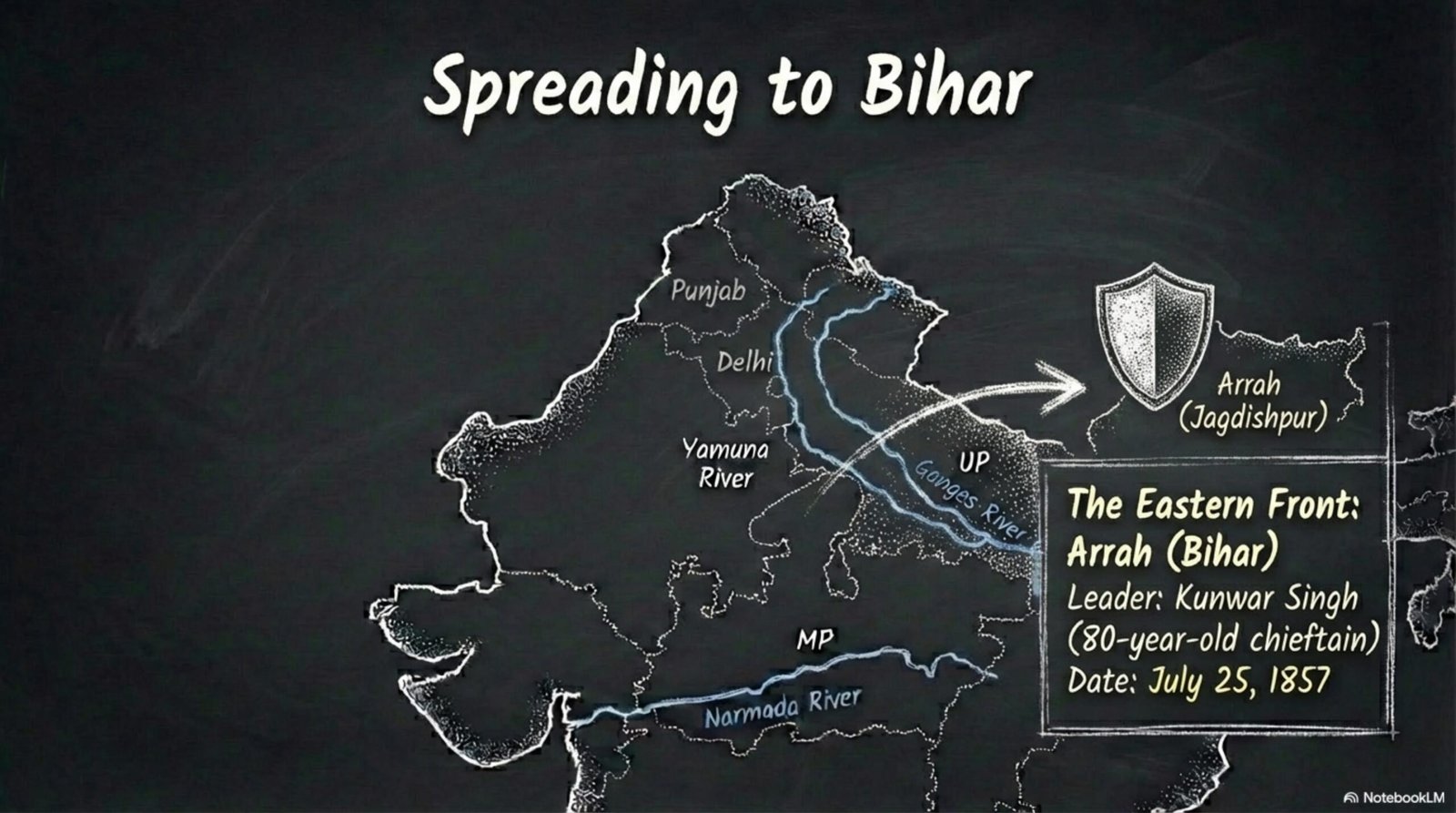
🛡️ The Eastern Front: Arrah, Bihar: The revolt spread eastward to Bihar, where Kunwar Singh, an 80-year-old chieftain from Jagdishpur near Arrah, led the resistance on July 25, 1857, demonstrating that age was no barrier to fighting for freedom.
📸 Image Insertion Instructions:
- Upload
page_008.jpgto WordPress Media Library - Copy the image URL from Media Library
- Replace
UPLOAD_IMAGE_HEREabove with the copied URL - Verify the image displays correctly in preview
The revolt didn’t stop at Uttar Pradesh and Madhya Pradesh—it spread eastward into Bihar, where it found an unlikely but remarkable leader: Kunwar Singh, an 80-year-old zamindar (landowner) from Jagdishpur near the town of Arrah.
Kunwar Singh: The Veteran Warrior
At an age when most people would be enjoying retirement, Kunwar Singh took up arms against the British. Born in 1777, he had witnessed the gradual expansion of British power throughout his lifetime and had his own grievances—the British had confiscated parts of his estate, and he resented their interference in local affairs.
When the revolt reached Bihar on July 25, 1857, Kunwar Singh organized a rebel army and launched guerrilla attacks against British forces. Despite his advanced age, he proved to be a brilliant military tactician, using his knowledge of local terrain to outmaneuver British troops repeatedly.
The Remarkable Campaign:
What makes Kunwar Singh’s story particularly inspiring is his resilience. During one battle, he was shot in the arm. Knowing that gangrene would set in, he reportedly cut off his own arm with his sword and threw it into the Ganges River, declaring that this was his offering to Mother Ganga. He continued fighting for several more months despite this injury.
Kunwar Singh led his forces in numerous successful engagements against the British, liberating several areas in Bihar and even parts of eastern Uttar Pradesh. He died on April 26, 1858, just three days after successfully defending his ancestral home at Jagdishpur from a British attack. He was 80 years old.
Why Bihar Mattered:
- Eastern Extension: Bihar represented the easternmost extent of the revolt, showing its wide geographical spread
- Guerrilla Warfare: The Bihar campaign demonstrated effective guerrilla tactics that prolonged the revolt
- Local Leadership: Kunwar Singh showed that the revolt wasn’t just led by dispossessed rulers but also by local leaders with popular support
- Age No Barrier: His leadership at 80 years old inspired people of all ages to join the resistance
- Strategic Importance: Control of Bihar was important for British communications between Calcutta and northern India
💡 Interesting Fact:
Kunwar Singh is one of the few leaders of the 1857 revolt who died unconquered. While most other centers fell to British forces, he successfully defended Jagdishpur until his death from battle wounds. The Government of India issued a commemorative postage stamp in his honor in 1966.
Bareilly: The Rohilkhand Uprising (May 31, 1857)
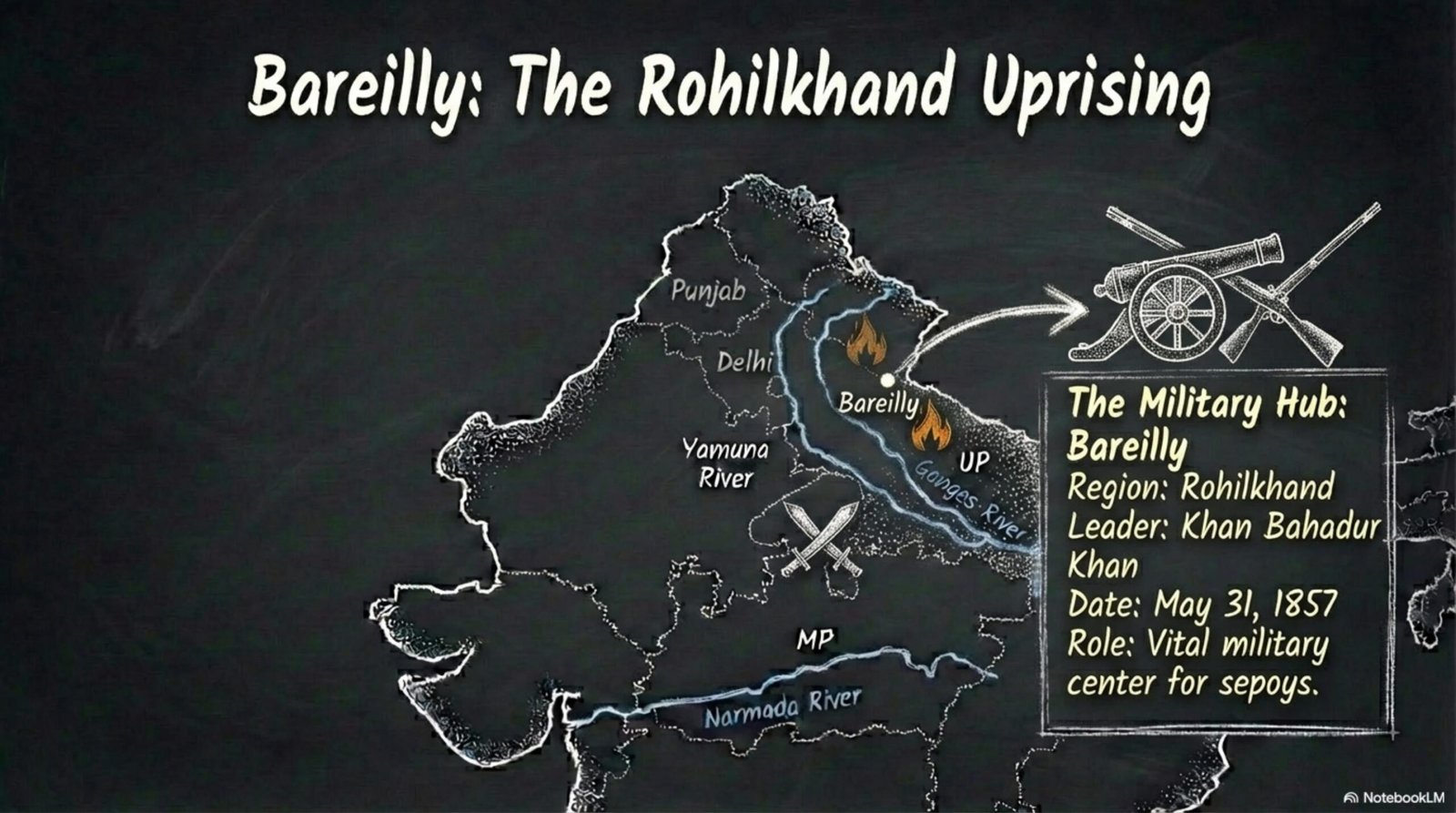
🏛️ The Military Hub: Bareilly: Located in the Rohilkhand region, Bareilly became a vital military center for sepoys under the leadership of Khan Bahadur Khan on May 31, 1857, serving as an important base for rebel operations.
📸 Image Insertion Instructions:
- Upload
page_009.jpgto WordPress Media Library - Copy the image URL from Media Library
- Replace
UPLOAD_IMAGE_HEREabove with the copied URL - Verify the image displays correctly in preview
In the Rohilkhand region of northern Uttar Pradesh, the city of Bareilly emerged as another significant center of the revolt. Unlike some other locations where civilian leaders took charge, Bareilly remained primarily a military stronghold throughout the uprising.
Khan Bahadur Khan: The Rohilla Leader
On May 31, 1857, the revolt reached Bareilly, and Khan Bahadur Khan, a descendant of the former Rohilla rulers of the region, was proclaimed the leader. The Rohillas were Pashtun people who had settled in this region in the 18th century and established a powerful state before being defeated by the British.
Khan Bahadur Khan organized the rebel forces in Bareilly and established it as a major military base. The city’s strategic location made it an important center for coordinating rebel activities across the Rohilkhand region.
Bareilly’s Military Significance:
Bareilly was home to a large British military cantonment, and when the sepoys there rebelled, they gained access to significant military resources—weapons, ammunition, and supplies. This made Bareilly one of the better-equipped rebel centers, capable of sustaining prolonged military operations.
The city served as a base for rebel operations throughout the region, with forces from Bareilly participating in battles across Rohilkhand. It remained under rebel control for several months before British forces recaptured it in May 1858.
Why Bareilly Mattered:
- Military Resources: The cantonment provided rebels with weapons and military supplies
- Strategic Location: Bareilly’s position made it a key point for controlling the Rohilkhand region
- Coordination Center: It served as a base for organizing rebel activities across northern UP
- Rohilla Heritage: The region’s history of resistance against British expansion gave the revolt local legitimacy
- Sustained Resistance: Bareilly remained under rebel control for nearly a year, demonstrating effective organization
The Complete Picture: Understanding the Shape of the Revolt
🗺️ Complete Picture of the Revolt: This comprehensive map shows all major centers—Meerut (spark), Delhi, Bareilly, Lucknow, Kanpur, Jhansi, and Arrah—concentrated in the North-Central Belt, with the timeline from May 1857 (start) to June 1858 (end at Gwalior).
📸 Image Insertion Instructions:
- Upload
page_010.jpgto WordPress Media Library - Copy the image URL from Media Library
- Replace
UPLOAD_IMAGE_HEREabove with the copied URL - Verify the image displays correctly in preview
Now that we’ve explored each major center individually, let’s step back and look at the complete picture. When you map all these locations together, a clear pattern emerges: the 1857 revolt was concentrated in the North-Central Belt of India, forming a rough oval shape across Uttar Pradesh, Madhya Pradesh, and Bihar.
The Geographical Pattern:
If you draw a circle encompassing all the major revolt centers, you’ll notice they form a connected region:
- Western Edge: Delhi and Meerut in the west
- Central Core: Lucknow, Kanpur, and Bareilly in the heart of Uttar Pradesh
- Southern Extent: Jhansi and Gwalior in Madhya Pradesh
- Eastern Reach: Arrah in Bihar
This geographical concentration had important implications for both the rebels and the British. For the rebels, it meant they could potentially coordinate their efforts and support each other. For the British, it meant they could surround the affected region and prevent the revolt from spreading to other parts of India.
The Timeline of Spread:
The revolt spread rapidly in its initial phase:
- May 10, 1857: Meerut (Day 1)
- May 11, 1857: Delhi (Day 2)
- May 30-31, 1857: Lucknow and Bareilly (Weeks 3-4)
- June 4-5, 1857: Jhansi and Kanpur (Week 4)
- July 25, 1857: Arrah (Month 3)
This rapid spread—from one city to multiple centers across a vast region in just three months—demonstrates how widespread the discontent against British rule was. It wasn’t a planned, coordinated uprising but rather a spontaneous explosion of resentment that found expression in multiple locations almost simultaneously.
Peak and Decline:
The revolt reached its peak in June-July 1857, when rebels controlled large parts of the North-Central region. However, by September 1857, the British had begun their counteroffensive, recapturing Delhi. Over the following months, they systematically recaptured other centers, with the final major battle occurring at Gwalior in June 1858.
Quick Review: Leaders and Locations
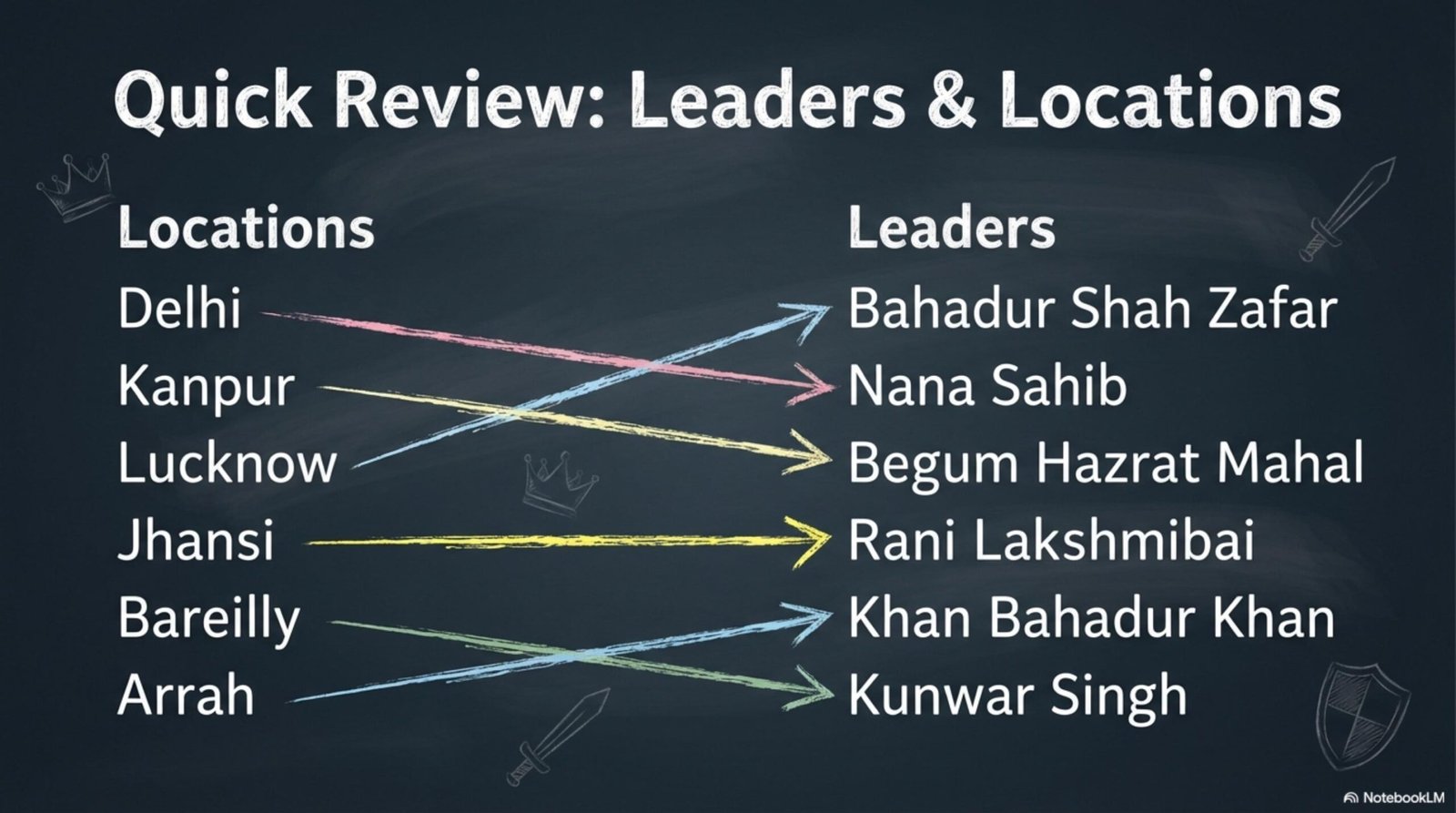
📊 Leaders & Locations Quick Reference: This diagram connects each major location with its prominent leader—Delhi with Bahadur Shah Zafar, Kanpur with Nana Sahib, Lucknow with Begum Hazrat Mahal, Jhansi with Rani Lakshmibai, Bareilly with Khan Bahadur Khan, and Arrah with Kunwar Singh.
📸 Image Insertion Instructions:
- Upload
page_011.jpgto WordPress Media Library - Copy the image URL from Media Library
- Replace
UPLOAD_IMAGE_HEREabove with the copied URL - Verify the image displays correctly in preview
To help you memorize the connection between locations and leaders, here’s a quick reference table that you should commit to memory for your exam:
| Location | Leader | Date | Significance |
|---|---|---|---|
| Meerut | Sepoys (no single leader) | May 10, 1857 | Starting point, first military rebellion |
| Delhi | Bahadur Shah Zafar | May 11, 1857 | Symbolic capital, Mughal emperor as figurehead |
| Lucknow | Begum Hazrat Mahal | May 30, 1857 | Capital of Awadh, fierce resistance |
| Kanpur | Nana Sahib | June 5, 1857 | Strategic location on Ganges, major battles |
| Jhansi | Rani Lakshmibai | June 4, 1857 | Warrior queen, symbol of resistance |
| Bareilly | Khan Bahadur Khan | May 31, 1857 | Rohilkhand region, military base |
| Arrah (Jagdishpur) | Kunwar Singh | July 25, 1857 | Bihar resistance, 80-year-old leader |
| Gwalior | Rani Lakshmibai & Tantia Tope | June 1858 | Final major battle, Rani Lakshmibai killed |
💯 Memory Trick:
D-L-K-J-B-A – Delhi (Bahadur Shah), Lucknow (Begum), Kanpur (Nana), Jhansi (Rani), Bareilly (Khan), Arrah (Kunwar). Use this acronym to remember the six most important centers with their leaders!
What is Missing from the Map? Understanding the Revolt’s Limitations
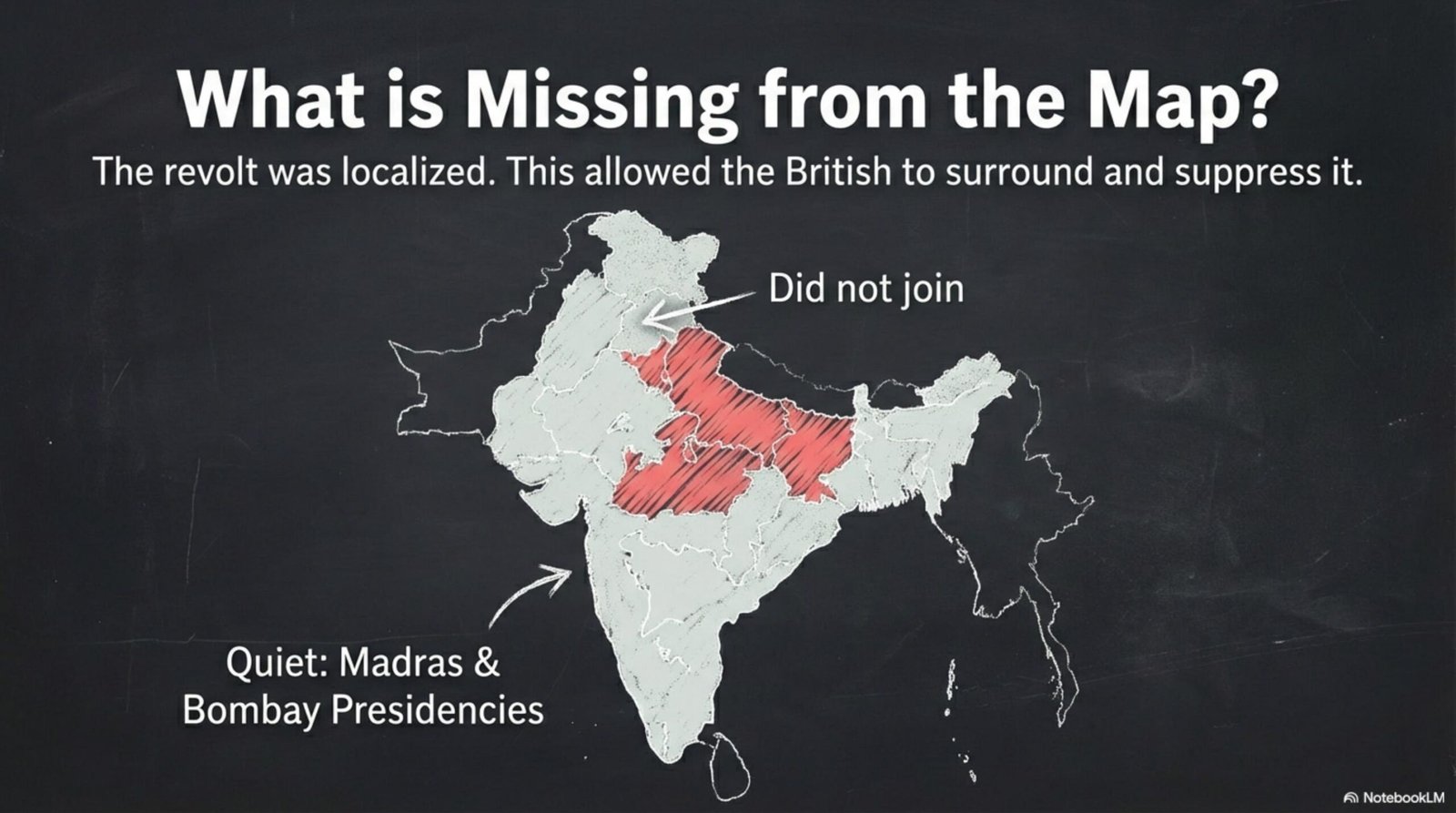
🗺️ What’s Missing: This map highlights that the revolt was localized to the North-Central Belt. Large regions including Madras and Bombay Presidencies in the south, Punjab in the northwest, and Bengal in the east remained largely quiet, allowing the British to surround and suppress the revolt.
📸 Image Insertion Instructions:
- Upload
page_012.jpgto WordPress Media Library - Copy the image URL from Media Library
- Replace
UPLOAD_IMAGE_HEREabove with the copied URL - Verify the image displays correctly in preview
Understanding what’s not on the map is just as important as understanding what is. The 1857 revolt, despite its intensity and significance, was geographically limited. Large parts of India did not participate in the uprising, and this limitation was a key factor in the British ability to suppress it.
Regions That Remained Quiet:
1. Southern India (Madras and Bombay Presidencies): The entire southern part of India, including present-day Tamil Nadu, Karnataka, Kerala, Andhra Pradesh, and parts of Maharashtra, remained largely peaceful. These regions had been under British control for longer, had different administrative systems, and didn’t have the same immediate grievances as the North.
2. Eastern India (Bengal): Although Bengal had been the center of British power since the Battle of Plassey (1757), it remained relatively quiet during the revolt. The Bengali intelligentsia and middle class had developed different relationships with British rule, and the region didn’t see the same level of military rebellion.
3. Western India (Parts of Bombay Presidency): Gujarat and western Maharashtra remained under British control throughout the revolt.
4. Punjab: Interestingly, Punjab—which had been annexed by the British only in 1849 after the Anglo-Sikh Wars—did not join the revolt. Sikh soldiers actually helped the British suppress the uprising, partly due to their own conflicts with the Mughal Empire historically.
Why This Localization Mattered:
- British Strategy: The localized nature allowed the British to bring troops from unaffected regions (especially Punjab and Madras) to suppress the revolt in the North-Central Belt
- Lack of All-India Coordination: The revolt never developed into a truly national movement with coordinated leadership across regions
- Easier Suppression: The British could surround the affected region and cut off supplies and reinforcements
- Different Grievances: Different regions had different relationships with British rule, and the immediate triggers (like the cartridge issue) didn’t affect all areas equally
- Communication Challenges: In 1857, communication across India was slow, making it difficult to coordinate a nationwide uprising
📚 Historical Analysis:
Historians debate whether the 1857 revolt was truly a “First War of Independence” or primarily a military mutiny. The fact that it remained geographically limited and lacked participation from large sections of Indian society is one argument used by those who see it more as a mutiny than a national independence movement. However, others argue that given the communication limitations of the era, the extent of the revolt was actually quite remarkable.
Exam Perspective: When answering questions about the revolt’s geographical spread, it’s important to mention both what areas participated and what areas didn’t. This shows the examiner that you understand the revolt’s limitations as well as its strengths.
Timeline: From Outbreak to Suppression
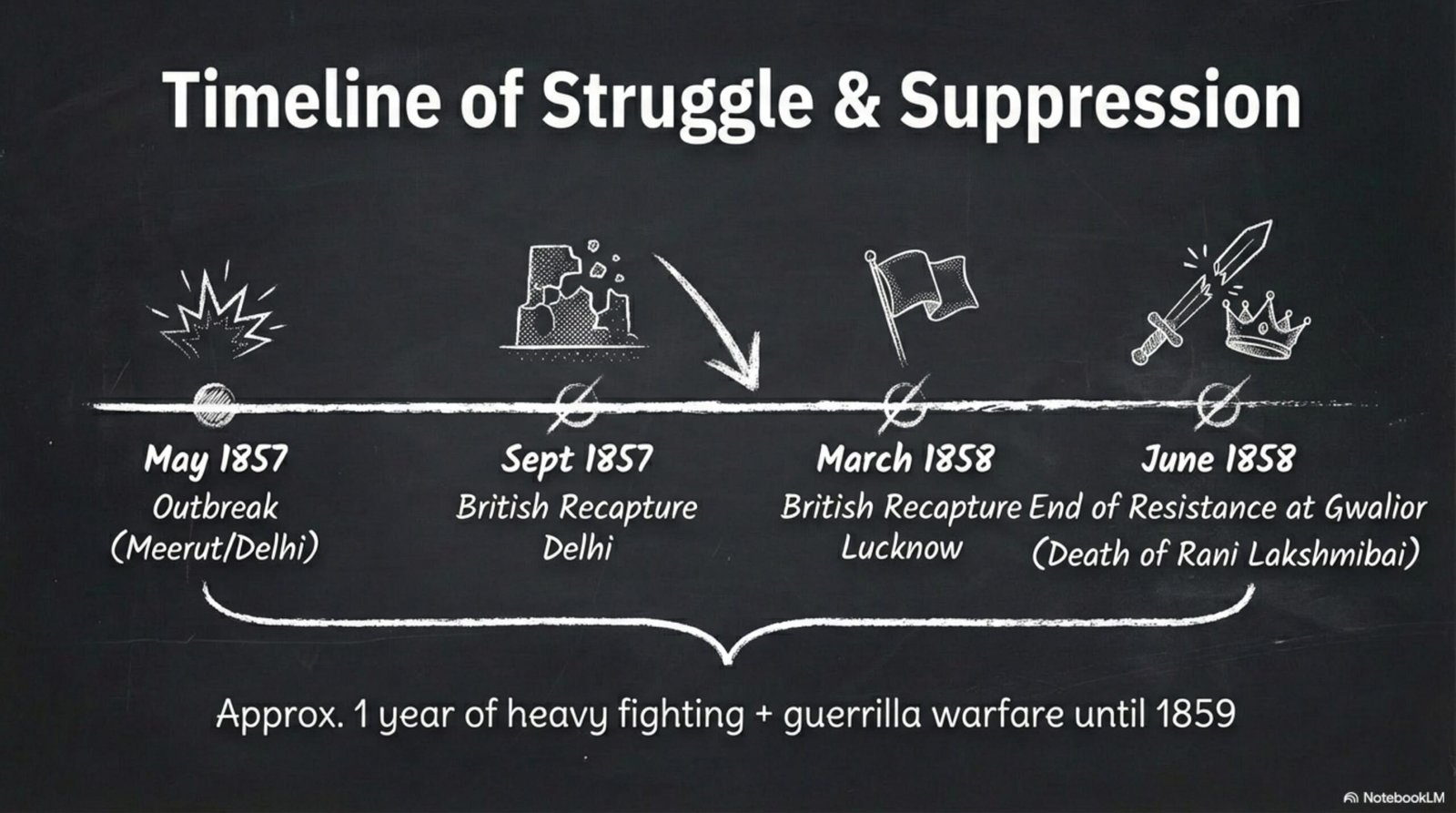
⏱️ Timeline of Struggle & Suppression: The revolt lasted approximately one year of heavy fighting, from the outbreak at Meerut/Delhi (May 1857), through British recapture of Delhi (September 1857) and Lucknow (March 1858), to the end of major resistance at Gwalior with the death of Rani Lakshmibai (June 1858), followed by guerrilla warfare until 1859.
📸 Image Insertion Instructions:
- Upload
page_014.jpgto WordPress Media Library - Copy the image URL from Media Library
- Replace
UPLOAD_IMAGE_HEREabove with the copied URL - Verify the image displays correctly in preview
Understanding the chronological progression of the revolt helps you see how it evolved from a spontaneous uprising to organized resistance, and finally to suppression. Here’s the complete timeline:
Outbreak
Meerut/Delhi
British Recapture
Delhi
British Recapture
Lucknow
End of Resistance
Gwalior (Death of Rani Lakshmibai)
📅 Duration: The revolt lasted approximately one year of heavy fighting (May 1857 – June 1858), followed by guerrilla warfare that continued until 1859. This makes it one of the longest and most widespread uprisings against colonial rule in the 19th century.
History is About People and Places
📚 Practice Makes Perfect: Remember, history is not just about memorizing dates—it’s about understanding people and places. Practice drawing this map from memory tonight to build your confidence for the exam!
📸 Image Insertion Instructions:
- Upload
page_015.jpgto WordPress Media Library - Copy the image URL from Media Library
- Replace
UPLOAD_IMAGE_HEREabove with the copied URL - Verify the image displays correctly in preview
As this visual guide emphasizes, history is not just a collection of dates and facts to be memorized. It’s about understanding people—their motivations, their courage, their struggles—and places—the geographical contexts that shaped historical events.
When you map the 1857 revolt, you’re not just drawing dots on paper. You’re connecting with the stories of Rani Lakshmibai’s bravery, Kunwar Singh’s determination at 80 years old, Begum Hazrat Mahal’s leadership, and the courage of ordinary sepoys who stood up against injustice despite knowing the risks.
Each location on your map represents real people who made difficult choices, fought for what they believed in, and shaped the course of Indian history. Understanding this human dimension makes history come alive and helps you remember the facts much more easily.
📝 Homework Challenge:
Tonight, before going to bed, try drawing the complete map of the 1857 revolt from memory. Mark all major centers, write the leaders’ names, and add dates. Time yourself—can you complete it in 7 minutes? This practice will build your confidence and ensure you’re fully prepared for your exam!
✅ Key Points to Remember
- Starting Point: Meerut (May 10, 1857) – Sepoys refused greased cartridges and rebelled
- Symbolic Capital: Delhi (May 11, 1857) – Bahadur Shah Zafar proclaimed leader for legitimacy
- Major Centers: Lucknow (Begum Hazrat Mahal), Kanpur (Nana Sahib), Jhansi (Rani Lakshmibai), Bareilly (Khan Bahadur Khan), Arrah (Kunwar Singh)
- Final Battle: Gwalior (June 1858) – Rani Lakshmibai killed in action
- Timeline: May 1857 (outbreak) to June 1858 (end of major resistance), guerrilla warfare until 1859
- Geographical Spread: Primarily North-Central Belt covering Uttar Pradesh, Madhya Pradesh, and Bihar
- What Didn’t Join: Madras and Bombay Presidencies, Bengal (largely), Punjab – this localization helped British suppress the revolt
- Key Rivers: Yamuna, Ganges, and Narmada served as geographical reference points and communication corridors
- Exam Focus: Be able to mark 4-5 major centers with dates and leaders, show spread with arrows, mention timeline
- Duration: Approximately one year of heavy fighting, making it one of the longest uprisings against colonial rule
📝 Perfect Exam Answer Format (5 Marks)
🎯 Typical Exam Question: “On an outline map of India, mark and label the major centers of the 1857 revolt. Also mention the leaders associated with each center.” (5 marks)
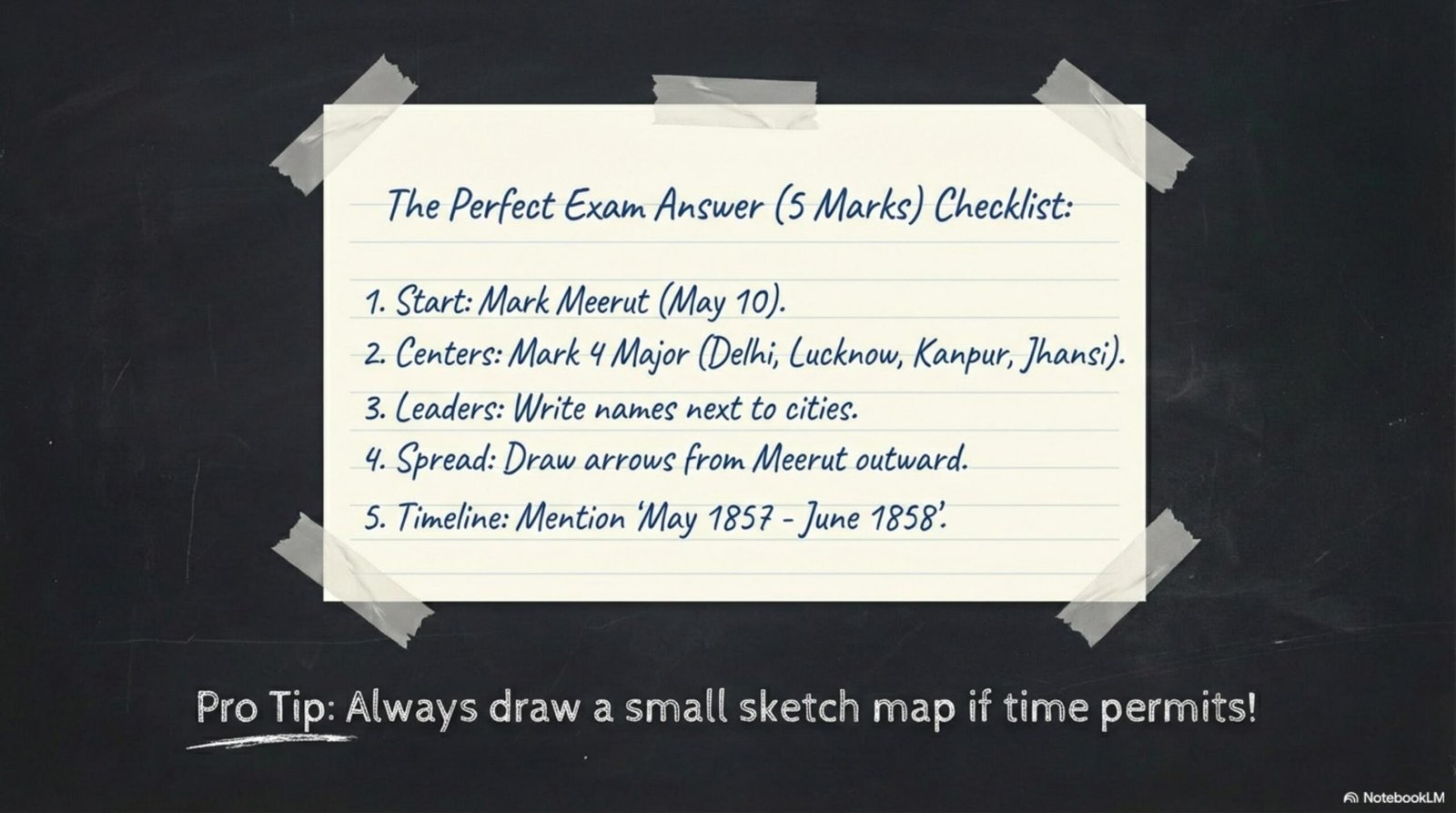
📋 The Perfect Exam Answer Checklist: Follow these 5 steps—(1) Start with Meerut (May 10), (2) Mark 4 major centers (Delhi, Lucknow, Kanpur, Jhansi), (3) Write leaders’ names next to cities, (4) Draw arrows from Meerut outward, (5) Mention timeline ‘May 1857 – June 1858’.
📸 Image Insertion Instructions:
- Upload
page_013.jpgto WordPress Media Library - Copy the image URL from Media Library
- Replace
UPLOAD_IMAGE_HEREabove with the copied URL - Verify the image displays correctly in preview
Now let’s break down exactly how to answer this question to get full marks. This is one of the most predictable questions in Class 8 History, so mastering it guarantees you 5 marks in your exam!
Marking Scheme Breakdown
How Marks Are Distributed
| Component | Marks |
|---|---|
| Marking Meerut as starting point with date (May 10, 1857) | 1 |
| Marking 4 major centers correctly (Delhi, Lucknow, Kanpur, Jhansi) | 2 |
| Writing leaders’ names next to each city | 1 |
| Drawing arrows showing spread from Meerut outward | 0.5 |
| Neatness, clear labeling, and overall presentation | 0.5 |
| Total | 5 |
Step-by-Step Answer Writing
Draw the Outline Map
Start by drawing a rough outline of India. Don’t waste time on perfect borders—a recognizable shape is enough. Focus on the North-Central region where the revolt occurred. You can lightly sketch state boundaries for UP, MP, and Bihar, but this isn’t mandatory.
⏱️ Time: 1-2 minutes
Mark Meerut First
Mark Meerut with a clear, distinct symbol (★ or ⚡) and write “Meerut – May 10, 1857” next to it. This shows you understand the chronological sequence and that Meerut was the starting point. Place it in the northern part of UP, slightly northeast of where Delhi would be.
⏱️ Time: 30 seconds
Mark 4 Major Centers
Mark these four cities with clear dots (●):
- Delhi – Central position, slightly southwest of Meerut
- Lucknow – Eastern UP, along the Ganges
- Kanpur – Central UP, also along the Ganges, between Delhi and Lucknow
- Jhansi – Southern UP/northern MP, below the Ganges valley
⏱️ Time: 1 minute
Write Leaders’ Names
Next to each city, clearly write the leader’s name:
- Delhi – Bahadur Shah Zafar
- Lucknow – Begum Hazrat Mahal
- Kanpur – Nana Sahib
- Jhansi – Rani Lakshmibai
⏱️ Time: 1-2 minutes
Draw Arrows Showing Spread
Draw arrows (→) from Meerut outward to show how the revolt spread. You can draw one arrow from Meerut to Delhi, then arrows from Delhi to other centers. This visual element demonstrates your understanding of the geographical progression of the revolt.
⏱️ Time: 1 minute
Add Timeline (Optional but Impressive)
If time permits, add a small timeline at the bottom or in a corner: “May 1857 – June 1858”. This shows comprehensive understanding and can earn you bonus appreciation from the examiner, even though it’s not explicitly required.
⏱️ Time: 30 seconds
⏱️ Total Time: 5-7 minutes
This is perfect for a 5-mark question. Don’t spend more than 7 minutes on this, as you need time for other questions! With practice, you can easily complete this in 5-6 minutes.
Do’s and Don’ts
✅ DO
- Mark Meerut as the starting point
- Write dates next to locations (at least for Meerut)
- Use clear, distinct symbols (★, ●, ⚡)
- Write neatly and legibly
- Draw arrows to show spread pattern
- Label all major centers clearly
- Mention key leaders next to cities
- Keep the map simple and clear
- Use a pen for final answer (not pencil)
- Leave some space between labels for clarity
❌ DON’T
- Don’t draw perfect borders (waste of time)
- Don’t mark too many locations (stick to 4-5 major ones)
- Don’t use only pencil for final answer
- Don’t forget to label clearly
- Don’t skip Meerut or Delhi (most important)
- Don’t write long paragraphs on the map
- Don’t spend more than 7 minutes
- Don’t leave the map unlabeled
- Don’t use colors unless specifically asked
- Don’t make the map too small or too large
What a Perfect Answer Looks Like
A perfect 5-mark answer for this question would include:
📍 Clear Map: A recognizable outline of India with focus on the North-Central region. The map doesn’t need to be perfect, but it should be clear enough to identify the locations. Think “functional” not “artistic”!
⭐ Starting Point: Meerut clearly marked with a distinct symbol (like ★) and labeled “Meerut – May 10, 1857” to show it as the origin of the revolt.
🏛️ Major Centers: Delhi, Lucknow, Kanpur, and Jhansi marked with dots and clearly labeled with their names in legible handwriting.
👑 Leaders: Names of leaders written next to their respective cities—Bahadur Shah Zafar (Delhi), Rani Lakshmibai (Jhansi), Begum Hazrat Mahal (Lucknow), Nana Sahib (Kanpur).
➡️ Spread Pattern: Arrows drawn from Meerut to other centers showing the geographical spread of the revolt. This can be simple arrows (→) connecting the cities.
📅 Timeline: Optional but impressive—a small note mentioning “May 1857 – June 1858” to show the duration. This can be written in a corner or at the bottom of the map.
💯 Pro Tip for Full Marks:
Examiners look for three things: accuracy (correct locations), clarity (legible labels), and completeness (all required elements included). Even if your map isn’t artistically perfect, you’ll get full marks if you’ve marked all required locations correctly with proper labels and leaders’ names. Neatness and clear presentation matter more than artistic skill!
Common Mistakes to Avoid
Learn from Others’ Mistakes
❌ Mistake 1: Forgetting Meerut
Some students mark Delhi as the starting point and forget Meerut entirely. Remember: Meerut (May 10) came BEFORE Delhi (May 11). Missing Meerut costs you 1 full mark!
❌ Mistake 2: Wrong Leader-Location Pairing
Mixing up leaders and locations is common. Double-check: Rani Lakshmibai = Jhansi (not Lucknow), Nana Sahib = Kanpur (not Delhi), Begum Hazrat Mahal = Lucknow (not Kanpur).
❌ Mistake 3: Illegible Handwriting
If the examiner can’t read your labels, you lose marks even if the locations are correct. Write clearly and leave space between labels.
❌ Mistake 4: Spending Too Much Time
Some students spend 15-20 minutes trying to draw a perfect map. This is a 5-mark question—don’t sacrifice time from 8-mark or 10-mark questions!
❌ Mistake 5: Marking Too Many Locations
Trying to mark 10-12 locations makes the map cluttered and confusing. Stick to 4-5 major centers for a clean, clear answer.
📝 Practice Questions
Test your understanding with these practice questions:
1. Why is Meerut considered the starting point of the 1857 revolt? (2 marks)
2. Name any four major centers of the 1857 revolt along with their leaders. (4 marks)
3. On an outline map of India, mark and label: (5 marks)
- Meerut (with date)
- Delhi (with leader’s name)
- Lucknow (with leader’s name)
- Jhansi (with leader’s name)
- Kanpur (with leader’s name)
4. Explain the geographical spread of the 1857 revolt. Why was it limited to the North-Central belt? (5 marks)
5. Write a short note on the role of Rani Lakshmibai in the 1857 revolt. (3 marks)
6. What was the timeline of the 1857 revolt? Mention the starting and ending dates with key events. (3 marks)
7. Compare the roles of Delhi and Meerut in the 1857 revolt. (3 marks)
8. “The 1857 revolt was localized, which helped the British suppress it.” Explain this statement with examples. (5 marks)
💡 Tip: Try answering these questions without looking at the content above. Then check your answers to see how well you’ve understood the topic! For map questions, actually draw the map on paper—this physical practice is crucial for exam preparation.
❓ Frequently Asked Questions
Q1. Why did the revolt start at Meerut and not somewhere else?
Meerut had a large concentration of Indian sepoys (soldiers) in the British army. When 85 sepoys were court-martialed and imprisoned for refusing to use the new Enfield rifle cartridges (which had grease offensive to both Hindus and Muslims), it sparked immediate outrage among their fellow soldiers. The proximity to Delhi (just 70 km away) also made it strategically important, as rebels could quickly march to the symbolic capital to seek legitimacy for their uprising. Additionally, Meerut had one of the largest military cantonments, providing the manpower needed for a significant rebellion.
Q2. Do I need to draw a perfect map in the exam?
No! Examiners don’t expect artistic perfection. What matters is: (1) A recognizable outline of India, (2) Accurate placement of locations, (3) Clear labeling with names and dates, (4) Proper marking of leaders. Even a rough sketch will get full marks if these elements are correct. Focus on accuracy and neatness, not artistic beauty. A simple, clear map is better than a detailed but messy one. Think of it as a functional diagram, not an art project!
Q3. Which are the most important centers to remember for exams?
The four most critical centers are: (1) Meerut – Starting point (May 10, 1857), (2) Delhi – Symbolic capital, Bahadur Shah Zafar, (3) Lucknow – Begum Hazrat Mahal, capital of Awadh, (4) Jhansi – Rani Lakshmibai. If you remember these four with their leaders and dates, you can answer most exam questions confidently. Additional centers like Kanpur (Nana Sahib), Bareilly (Khan Bahadur Khan), and Arrah (Kunwar Singh) are bonus points that can help you score extra marks, but the first four are absolutely essential.
Q4. Why didn’t the revolt spread to South India?
The revolt was largely limited to the North-Central belt for several reasons: (1) The Madras and Bombay Presidencies had different administrative systems and less military presence, (2) The new Enfield rifle cartridges were primarily distributed to northern regiments, so the immediate trigger didn’t affect southern soldiers, (3) Southern regions had been under British control for longer and had less direct grievances against recent policies like the Doctrine of Lapse, (4) The revolt lacked coordinated all-India leadership to spread it nationwide, (5) Communication in 1857 was slow, making it difficult to coordinate across vast distances. This localization actually helped the British suppress the revolt more effectively by surrounding the affected regions with troops from unaffected areas.
Q5. What’s the difference between the roles of Delhi and Meerut?
Meerut was the starting point—where the actual military rebellion began on May 10, 1857, when sepoys refused greased cartridges and rebelled. Delhi was the symbolic capital—rebels marched there the very next day to proclaim Bahadur Shah Zafar (the last Mughal emperor) as their leader, giving the revolt political legitimacy and a unifying figurehead. Think of it this way: Meerut provided the spark (military action), while Delhi provided the symbol (political legitimacy). Both were crucial but served different purposes. Without Meerut, there would be no revolt; without Delhi, the revolt would have lacked the symbolic authority needed to attract wider support.
Q6. How much time should I spend on a 5-mark map question?
Ideally, spend 5-7 minutes on a 5-mark map question. Break it down: 1-2 minutes for the outline, 1 minute for marking locations, 1-2 minutes for labeling with names and dates, 1 minute for arrows/symbols, and 30 seconds for final check. Don’t exceed 7 minutes, as you need time for other questions. With practice, you can easily complete this in 5-6 minutes. Practice drawing the map multiple times at home with a timer to build speed and accuracy. Remember, this is a predictable question where you can score full marks easily—don’t let time management cost you marks!
Q7. Can I use pencil for drawing the map?
It depends on your exam instructions. Generally, for CBSE board exams, you should use a pen for final answers, including maps. However, you can lightly sketch the outline in pencil first, then trace over it with pen for the final answer. Check your specific exam guidelines. If using pen, use a fine-tip pen (not a thick marker) for neat lines and clear labeling. Blue or black pen is standard—avoid using multiple colors unless specifically instructed. The key is that your final answer should be in pen, as pencil answers may not be evaluated or may be considered incomplete.
About the Author
Danish Elchi
Subject Matter Expert – History & Social Science
Danish Elchi is a dedicated subject matter expert specializing in History and Social Science. Known for his ability to make historical events come alive and geography concepts relatable, he has helped numerous students develop a genuine interest in social studies while excelling in their exams. His visual teaching approach makes complex historical events easy to understand and remember.
Connect on LinkedIn📚 More Class 8 History Resources
Explore more comprehensive guides and visual learning resources for Class 8 CBSE History on AskFarhan.com
✨ Visual guides • Exam strategies • Practice questions • Expert explanations