
Analysis
Clarity Act Stalls: Is Bitcoin Already Pricing the Fallout?
Clarity Act Stalls: Is BTC Already Pricing the Fallout?
Sixty-four thousand, one hundred forty-eight dollars. That's where Bitcoin sits right now — dead in the middle of its own eight-week range. And yet the headlines are screaming that a single Senate bill just decided the fate of every altcoin in your portfolio.
So which is it? Is the Clarity Act about to send XRP to eight dollars, or did the whole vote just collapse into recess? Right now, two sets of headlines are telling you two completely different stories, and your portfolio can't hold both.

Two Headlines, One Bill
The bill in question is H.R. 3633 — the Clarity Act, the market structure legislation crypto has been asking Congress for since 2023. It's meant to finally draw a clear line between what the SEC regulates and what falls under the CFTC, ending years of enforcement-by-lawsuit.
The confirmed layer of this story is short but real. These are on-record statements, not speculation:
- Coinbase CEO Brian Armstrong is publicly pushing for passage.
- Treasury Secretary Scott Bessent is backing the bill too, reportedly closing his pitch with a Satoshi Nakamoto quote.
- American Bankers Association CEO Rob Nichols is floating small, 'surgical' edits to smooth its path through the Senate.
- SEC Commissioner Hester Peirce says she's optimistic about where things stand.

That's the confirmed layer. What's missing from every single one of these reports is a scheduled floor vote. Not one credible source names an actual date. That gap is exactly what the entire noisy narrative is built on.
Senate Stalls Clarity Act Ahead of August Recess
Here's where the story splits. One outlet's headline literally reads 'Senate Vote Collapses.' Another says the bill is 'moving again.' A third insists tomorrow is critical. A fourth just says a vote is 'incoming.' Those claims cannot all be true at the same time — and that contradiction is the tell.
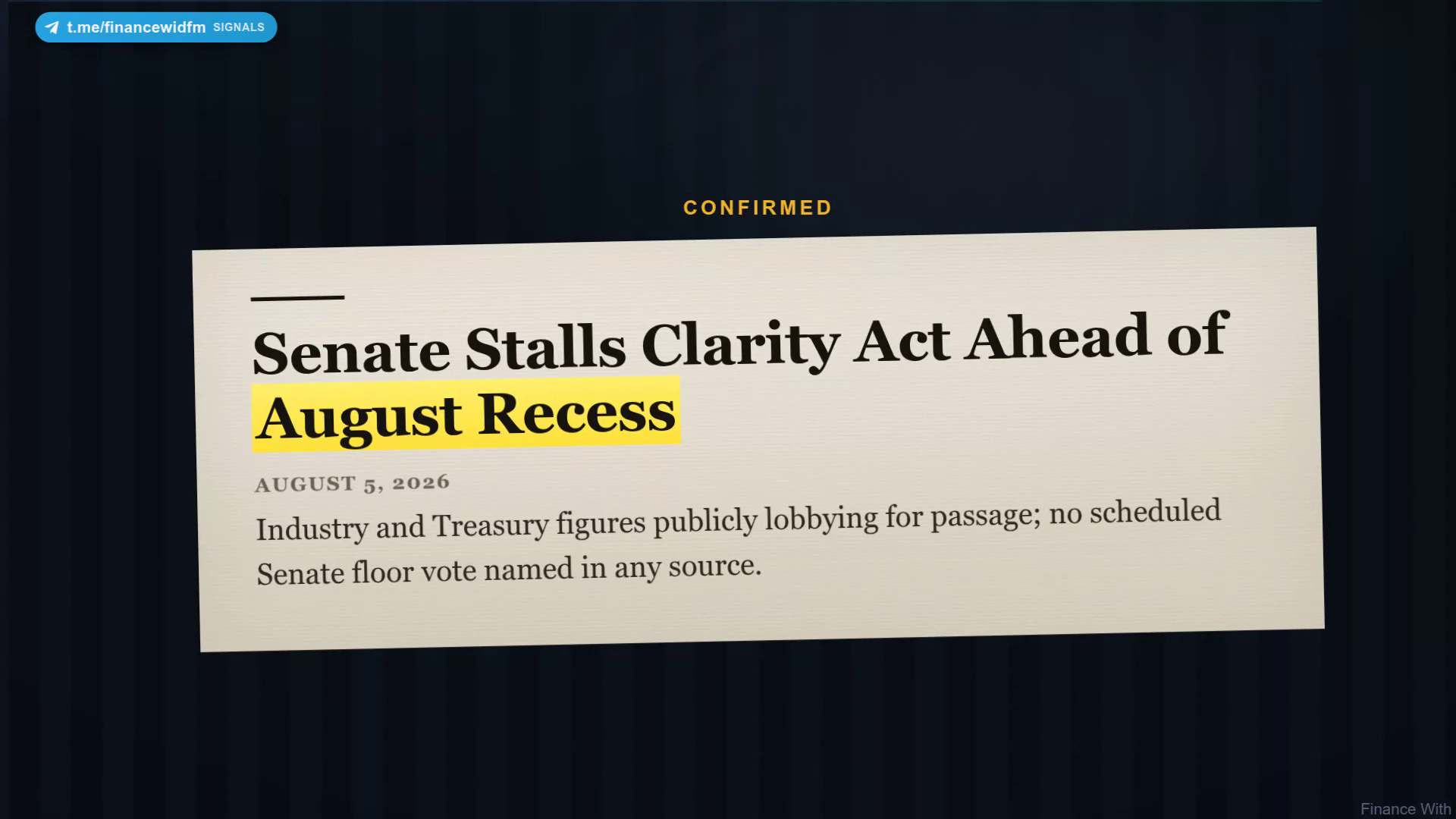
Congress is heading into its August recess, and market structure bills have a long history of getting parked right before a break, only to resurface weeks later with no real change in substance. Until the Senate calendar shows a scheduled vote, 'stalled' and 'moving again' are both just descriptions of the same limbo.
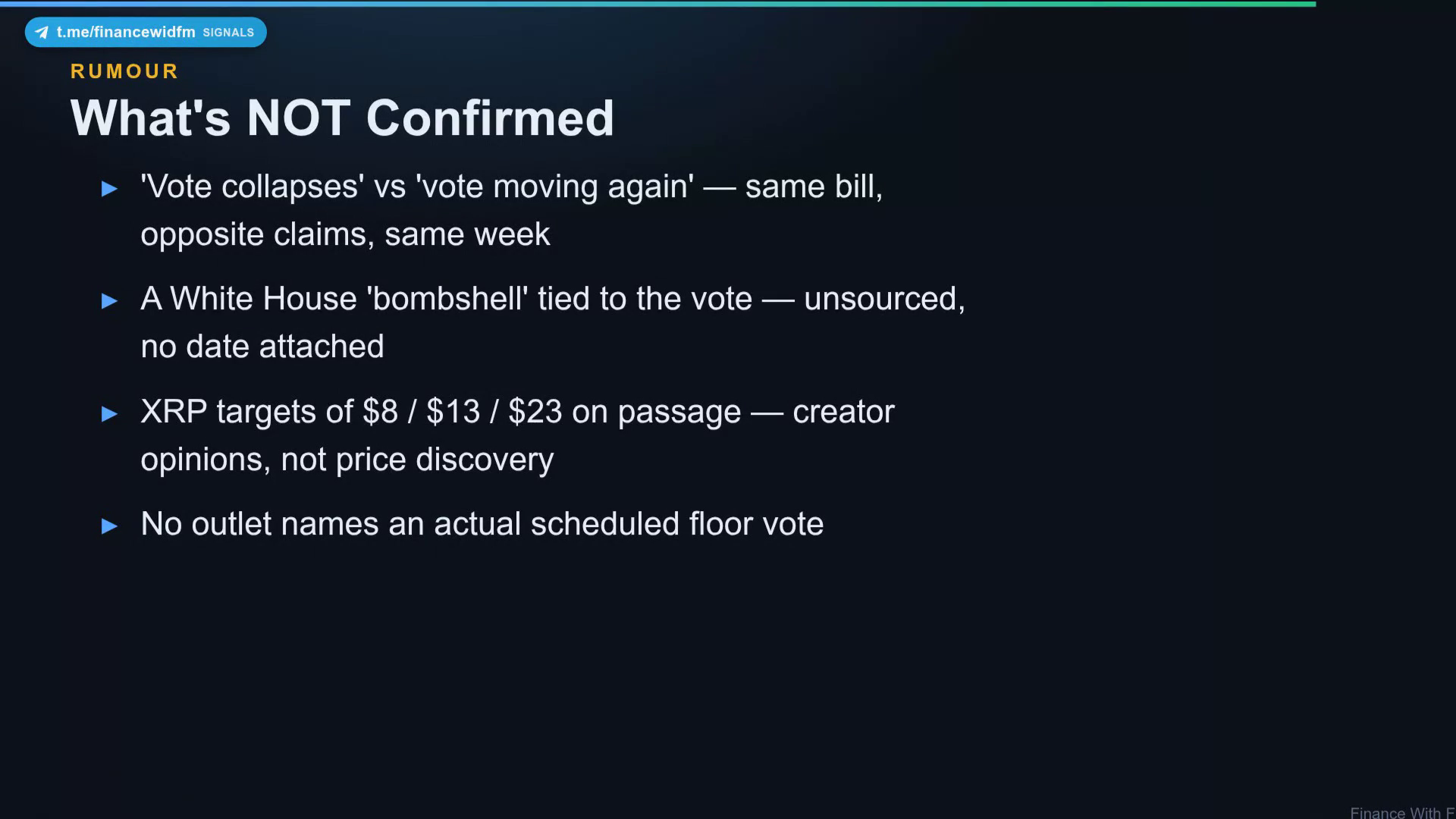
What's NOT Confirmed
There's a claim circulating that the White House has some bombshell announcement queued up tied to this vote — supposedly explosive for XRP specifically. There is no confirmation, no date, and no official statement attached to that claim anywhere. Treat it exactly as it is: a rumor with no paper trail.
On the retail side, you've probably seen video titles promising XRP at eight dollars, thirteen dollars, even twenty-three dollars if the Clarity Act passes. Those are price targets from content creators chasing clicks — not price discovery, not analyst forecasts, not anything derived from options markets or order flow.
Data, Not Vibes
So does any of this actually move the market? Look at the data instead of the headlines.
| Metric | Reading |
|---|---|
| BTC price | $64,148 |
| 8-week range | $57,800 – $67,292 |
| Funding rate (8h) | 0.0042% |
| Funding rate (annualized) | ≈4.63% |
| Position vs. 20-day MA | Below |
| Position vs. 200-day MA | Below |

Funding at roughly 4.63% annualized is flat. Neutral. No crowd is paying a real premium on either side, which tells you leveraged traders haven't actually placed a bet on this outcome. Bitcoin's current price also sits almost dead center of its 60-day range — if this were priced for a binary yes/no on the Clarity Act, you'd expect funding skewed hard in one direction and price pinned near a range edge. We're seeing neither.
That said, price sitting below both its 20-day and 200-day averages means some caution is already baked in. Call it partly priced in, not fully priced in.
Where a Move Runs Into Something
If a headline does land hard enough to actually move price, it won't move in a vacuum — it'll run straight into stacked liquidation clusters on either side.
| Level | Price | Type |
|---|---|---|
| 25x long liquidations | $61,555 | Downside magnet (further) |
| 50x long liquidations | $62,838 | Downside magnet (nearer) |
| 20-day MA (pivot) | $64,396 | Sits almost on current price |
| Short liquidations (near) | $65,403 | Upside magnet (nearer) |
| Short liquidations (far) | $66,685 | Upside magnet (further) |
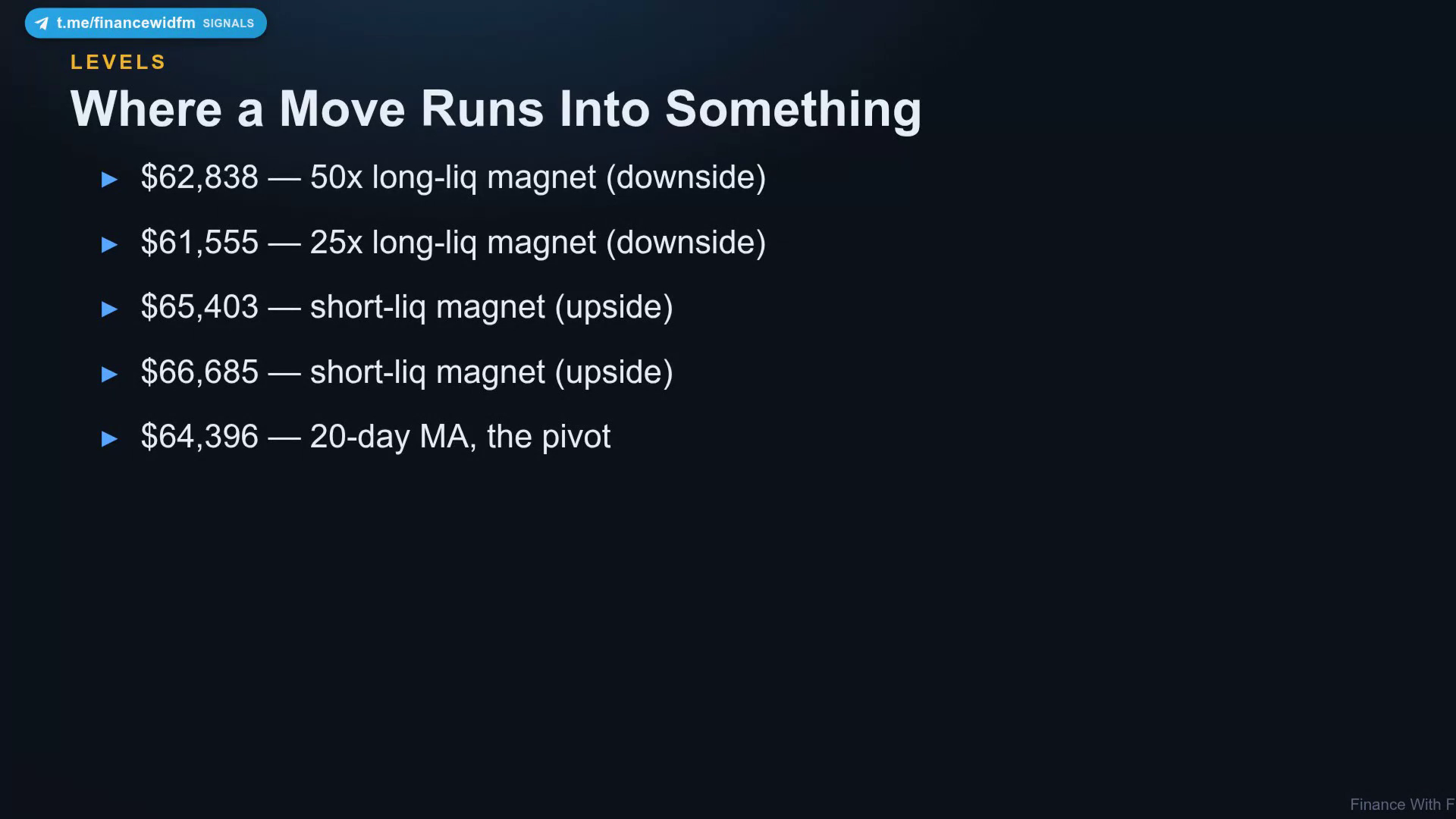
Worth repeating: these liquidation clusters aren't support or resistance in the classic technical-analysis sense. Price tends to hunt the heavier pool of stops nearby. Whichever direction the next round of headlines pushes sentiment, that's the magnet it's likely to reach — not necessarily where it stops for good.
Primary, Alternative, Invalidation
Here's how we're framing the three realistic paths from here, and what would actually need to happen to move from one to the next.
| Scenario | Trigger | Likely Outcome |
|---|---|---|
| Primary | No confirmed vote date | Stays headline noise inside $57.8k–$67.3k range; drifts 2–4% toward nearer liquidation cluster |
| Alternative | Confirmed dated Senate floor vote (pass or fail) | Flips from noise to real catalyst; watch for a close outside $61,555–$66,685 on rising open interest |
| Invalidation | Confirmed vote + close outside the band + OI climbing | Kills the 'still just noise' thesis entirely |
The invalidation condition is simple and non-negotiable: a confirmed dated vote plus a Bitcoin close outside that $61,555–$66,685 band plus open interest actually climbing. All three, together. That's the level to watch — not a headline, not a tweet, not a YouTube thumbnail.
What It Means For You
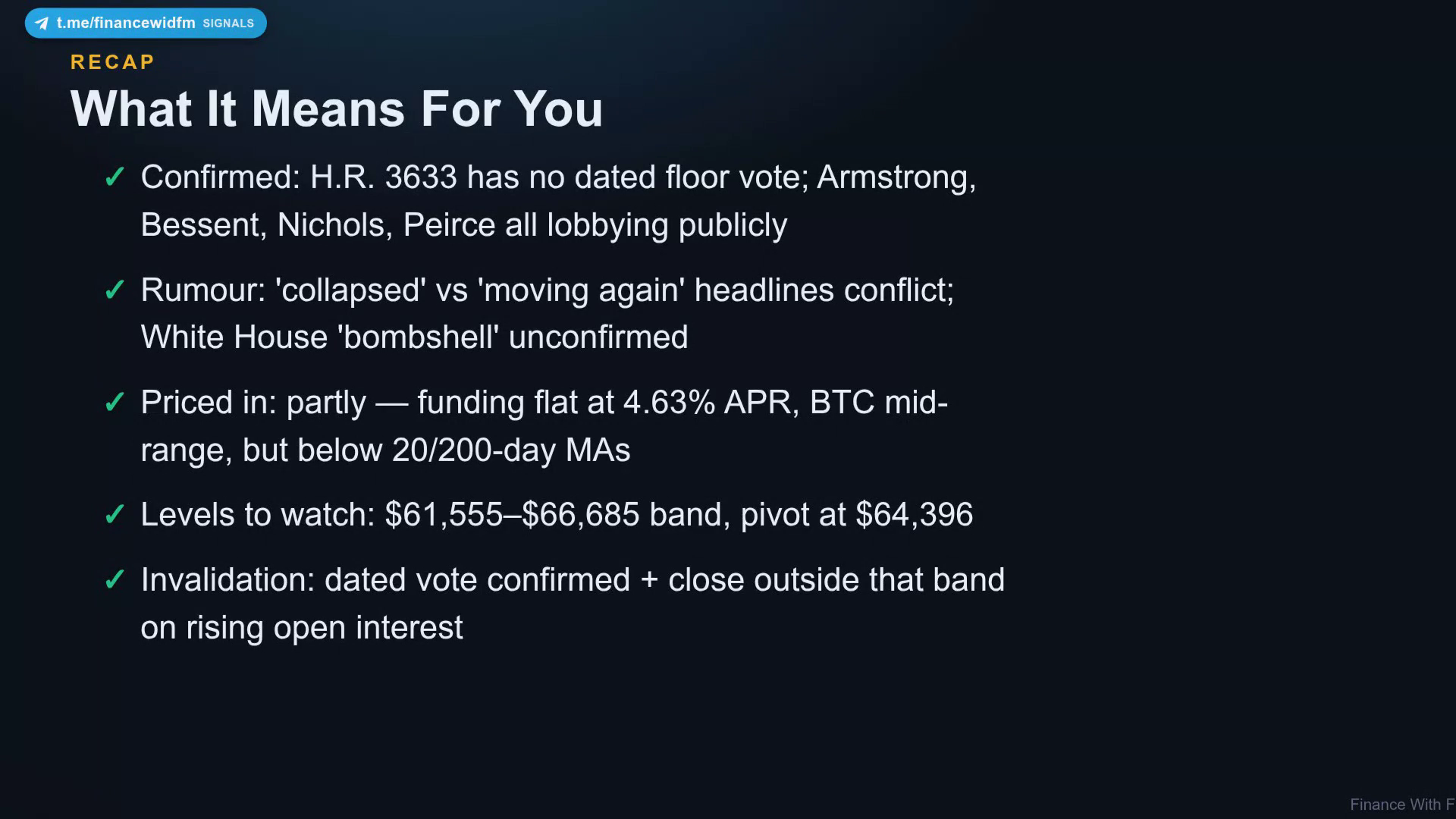
Don't trade the headlines — trade the calendar. Until H.R. 3633 gets an actual scheduled floor vote, this is noise inside a known range, and every 'collapse' or 'comeback' headline is just pushing price toward the nearest liquidation magnet, not creating a new trend.
- Watch the $61,555–$66,685 band as your reference range, not the news cycle.
- A confirmed vote plus a close outside that band, on rising open interest, is the actual signal.
- Treat XRP price targets ($8, $13, $23) tied to this bill as opinion until there's a dated vote and market pricing behind them.
- Flat funding right now means no one has real conviction — don't borrow conviction from a headline that doesn't have a date attached.
Key takeaways
- Bitcoin is trading at $64,148 — almost exactly mid-range of its $57,800–$67,292 eight-week band, not pricing a binary outcome.
- Funding rate sits flat at ~4.63% annualized, showing leveraged traders haven't placed a real directional bet on the Clarity Act's outcome.
- No source has confirmed an actual scheduled Senate floor vote for H.R. 3633 — every 'collapse' or 'comeback' headline is built on that missing date.
- The real level to watch is a close outside $61,555–$66,685 on rising open interest, paired with a confirmed dated vote.
- XRP price targets of $8–$23 tied to this bill are content-creator opinion, not market-derived forecasts — treat them as noise until proven otherwise.
Frequently asked questions
What is the Clarity Act?
H.R. 3633 is a proposed U.S. market structure bill that would draw clearer lines between SEC and CFTC jurisdiction over crypto assets, something the industry has sought since 2023.
Has the Clarity Act Senate vote been confirmed?
No. As of now, no source has named an actual scheduled floor vote date. Headlines calling it 'collapsed' or 'moving again' are both describing the same unconfirmed limbo.
Is Bitcoin's price already reflecting the Clarity Act outcome?
Only partially. BTC sits near the middle of its range with flat funding, suggesting the market hasn't placed a real directional bet yet — though trading below its 20-day and 200-day averages shows some caution is priced in.
What price levels matter most for BTC right now?
The key band is $61,555 to $66,685, framed by liquidation clusters. A confirmed vote date combined with a close outside that band on rising open interest would be the real signal, not the headlines themselves.
Are the $8–$23 XRP price predictions tied to the Clarity Act reliable?
No. Those figures come from content creators and speculative commentary, not confirmed legislation, official statements, or market pricing. They should be treated as opinion, not forecast.