
News
Crypto News Aug 8, 2026: The Vote That Changes Everything
Fear Grips Crypto as BTC Holds Firm
The market woke up nervous today. The Fear & Greed Index is pinned at 39 out of 100 — squarely in Fear territory — even though Bitcoin itself hasn't budged much. BTC is trading in a tight band between roughly $64,884 and $65,010 on the day, holding firm despite the anxious mood surrounding it.
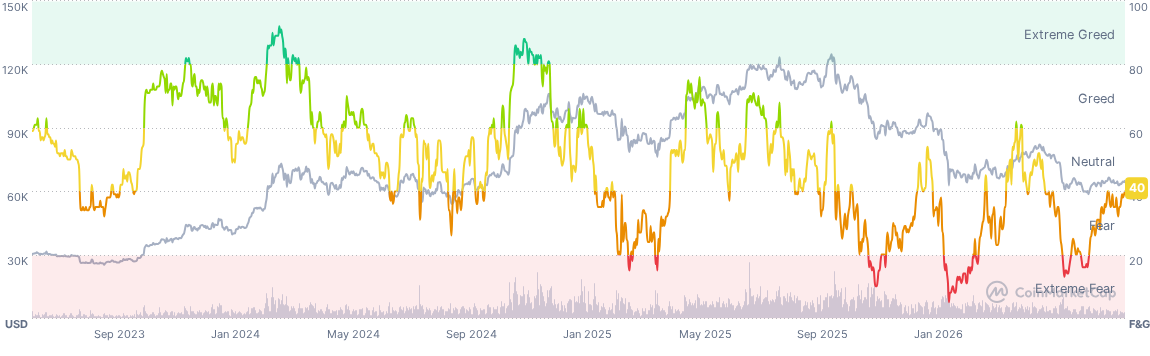
That disconnect between price and sentiment is the story in itself. Traders are watching Bitcoin dominance climb toward 59%, a level that typically signals capital rotating out of altcoins and into BTC as a safe harbor. Total crypto market cap sits around $2.2 trillion, up only slightly on the day — a market treading water while it waits for a catalyst.
| Metric | Current Reading |
|---|---|
| Fear & Greed Index | 39 / 100 (Fear) |
| Bitcoin price | ~$64,900 – $65,010 |
| BTC dominance | ~59% |
| Total market cap | ~$2.2 trillion |
For context, prediction markets currently give roughly a 96% probability that BTC closes today's session inside the $64,000–$66,000 range, which lines up with what we're seeing on the tape. This is a market coiling, not collapsing — but coiled markets can snap in either direction fast.
The Vote That Could Change Everything
This is the headline that matters most this week. The CLARITY Act — the market structure bill widely seen as crypto's biggest legislative moment in years — was expected to get a Senate vote before the summer recess. That didn't happen. Reporting from CoinDesk confirms the Senate will not vote on the bill before breaking for its scheduled recess, pushing the timeline into September.
There's a twist, though. Multiple sources indicate the Senate could delay its own recess specifically to force a vote through before lawmakers leave Washington, with a self-imposed window of roughly 15 days to get it done. Senate Majority Whip John Barrasso has publicly pushed for urgency, and the House Financial Services Committee has formally urged the Senate to act.
- If it passes: exchanges, stablecoin issuers, and DeFi platforms finally get a clear federal rulebook — the single biggest overhang removed from the industry in a decade.
- If it stalls again: expect continued regulatory ambiguity, more state-by-state patchwork enforcement, and hesitant institutional capital.
- Why it's called 'the vote': this bill defines whether a token is a security or a commodity — the question that has driven nearly every major SEC enforcement fight since 2021.
Why should a Zcash trader or a Hyperliquid degen care about a Senate procedural fight? Because market structure clarity is the single biggest unlock for institutional flow. Every story below — from stablecoin demand to exchange licensing — ultimately traces back to whether Washington finally writes the rules.
Bitcoin's Lightning Network Just Got Drained
Not every headline today is bullish. Hackers exploited vulnerabilities in payment servers connected to Bitcoin's Lightning Network, draining funds directly from routing nodes. Lightning is Bitcoin's flagship scaling solution — the layer that's supposed to make BTC usable for everyday, instant payments.
This isn't the first time speed and convenience have come at the cost of security. Lightning's architecture depends on always-online nodes and hot channels, which makes it a fundamentally different attack surface than Bitcoin's base layer. The exploit is a reminder that Layer 2 infrastructure — no matter how elegant on paper — still carries real custodial and operational risk.
Expect this to reignite the long-running debate between Lightning maximalists and advocates of alternative scaling paths like Bitcoin sidechains and rollups. Security incidents like this one tend to slow adoption curves even when the underlying protocol itself remains sound.
Zcash Reclaims $500 — But Two Levels Will Decide What's Next
On the brighter side of the ledger, Zcash (ZEC) has clawed its way back above $500 following the rollout of its Ironwood upgrade. The move has reignited confidence in a privacy coin that's spent much of the year fighting for relevance against newer privacy-tech narratives.
The catch: retail enthusiasm has returned, but big money hasn't confirmed the move yet. On-chain data shows relatively thin whale accumulation compared to the price bounce, which means this reclaim could be fragile until larger wallets step in.
| Level | Significance |
|---|---|
| $500 | Reclaimed psychological resistance — now needs to hold as support |
| Key support zone below $500 | If lost, confidence from the Ironwood rally fades fast |
| Key resistance zone above current price | A confirmed break here would suggest institutional follow-through |
TRON's Network Revenue Hits $37.8 Million
TRON (TRX) just posted network revenue of $37.8 million, a figure that puts it firmly in the conversation with the biggest fee-generating chains in the industry. Whale order sizes are climbing alongside this, even as TRX's price action stays surprisingly muted.
That divergence — rising fundamentals, flat price — is what traders call 'coiling.' The network is quietly outgrowing its own valuation, largely on the back of stablecoin settlement volume that flows through TRON's rails daily. Remember this number: it's directly relevant to the ongoing Bitcoin bear-market debate we'll circle back to, because stablecoin settlement activity is one of the clearest read-throughs on real on-chain demand versus speculative froth.
- Revenue: $37.8M, among the highest of any L1/L2 network currently reporting
- Whale accumulation: increasing order sizes despite sideways price
- Interpretation: usage is outrunning price — a setup that has historically preceded re-rating events, though timing is never guaranteed
Hyperliquid Torches $1.28 Million in a Single Day
Hyperliquid (HYPE) burned $1.28 million worth of its own token in just 24 hours, pushing lifetime burns to a staggering $2.68 billion. Token turnover has compressed to just 2.9%, a sign that supply dynamics are tightening meaningfully.
| Metric | Value |
|---|---|
| 24-hour burn | $1.28 million |
| Lifetime burns | $2.68 billion |
| Current turnover rate | 2.9% |
| Trader target being watched | $60 |
The $60 target now circulating among traders isn't pulled from thin air — it reflects the pace of burns holding steady while circulating supply continues to shrink. Whether HYPE gets there depends heavily on whether the broader fear-driven market (see our opening section) allows risk assets to run.
IMF: Domestic Stablecoins Could Actually Boost Dollar Demand
In a notable comment, the IMF's Dan Katz argued that domestic stablecoins could increase demand for dollar-backed tokens rather than cannibalize it. His reasoning rests on three pillars: liquidity depth, network effects, and cross-border acceptance — all of which favor dollar-pegged stablecoins over competing fiat-backed alternatives.
- Liquidity: deeper dollar stablecoin pools mean tighter spreads and better execution for global users
- Network effects: the more merchants, exchanges, and DeFi protocols default to USD stablecoins, the harder that dominance is to dislodge
- Cross-border acceptance: dollar stablecoins remain the default settlement rail in emerging markets, reinforcing the greenback's global reserve status even as physical dollar usage declines
This ties directly back to the CLARITY Act vote covered earlier. If the U.S. finally codifies clear rules for stablecoin issuers, comments like Katz's suggest the dollar's digital dominance could accelerate rather than fade — the opposite of what de-dollarization narratives have predicted.
Russia Cracks Down on Unlicensed Exchanges
Rounding out today's biggest stories, Russian regulators have moved to tighten enforcement against unlicensed crypto exchanges operating within the country. The crackdown reflects a broader global pattern: as more jurisdictions build formal licensing frameworks, tolerance for gray-market platforms is shrinking fast.
This mirrors exactly the kind of regulatory clarity debate playing out in Washington with the CLARITY Act. Whether it's a Senate vote on market structure or a Kremlin crackdown on unlicensed operators, the direction of travel globally is the same: less ambiguity, more formal oversight, and less room for platforms operating outside the rules.
Key takeaways
- Fear & Greed sits at 39 while BTC holds near $65K — a disconnect that historically resolves with a sharp move in either direction.
- The CLARITY Act vote was delayed past the Senate's summer recess deadline, pushing crypto's biggest regulatory decision into September — though lawmakers may still delay recess itself to force a vote.
- Zcash's reclaim of $500 after Ironwood is real, but lacks confirmed whale accumulation — watch the support/resistance zones before assuming the move is durable.
- Hyperliquid's $1.28M daily burn and shrinking 2.9% turnover rate are fueling a $60 price target among traders, contingent on demand holding up.
- Regulatory tightening is a global theme today — from Russia's exchange crackdown to the IMF's dollar-stablecoin comments to the stalled U.S. market structure bill.
Frequently asked questions
What is the CLARITY Act and why does it matter for crypto?
The CLARITY Act is a U.S. market structure bill that would define whether tokens are securities or commodities, giving exchanges and issuers a clear federal rulebook. It's considered the most consequential piece of crypto legislation pending in Congress.
Why did the Senate delay the crypto bill vote?
According to CoinDesk, the Senate did not vote on the CLARITY Act before its scheduled summer recess, pushing the decision into September, though some lawmakers are pushing to delay the recess itself to pass it sooner.
Is Bitcoin in a bear market right now?
Not based on price action — BTC is holding near $65,000 with high dominance near 59%. The Fear & Greed reading of 39 reflects cautious sentiment, but capital is rotating into Bitcoin rather than exiting crypto entirely.
What caused Zcash's price to reclaim $500?
Zcash's Ironwood upgrade, which improves shielded-transaction efficiency, drove renewed retail confidence and pushed ZEC back above the $500 level, though large-wallet accumulation hasn't yet confirmed the move.
What does Hyperliquid's token burn mean for HYPE's price?
Hyperliquid burned $1.28 million in HYPE in a single day, bringing lifetime burns to $2.68 billion and shrinking token turnover to 2.9%. Traders are watching this supply squeeze as a potential setup toward a $60 price target.