
Lessons
Forex Market Structure: Why Broker Prices Differ
The Ten-Second Gap That Confused Sam
Sam pulls up his charts. Ten seconds later his buddy texts him a screenshot — same currency pair, same instant, different broker app. The two numbers don't match. Not by much, a few pips, but enough that Sam starts wondering if his broker is quietly ripping him off.
Here's the uncomfortable truth: neither price is wrong. In forex, there is no single official price anywhere on earth. Not one exchange, not one number everybody agrees on. That sounds broken until you understand it's actually the whole design.
Today we're taking apart the structure underneath every quote you'll ever see — the ladder that runs from the biggest banks on the planet down to the app on Sam's phone. Once you see this ladder, you'll never look at a quote the same way again.
The Stock Market: One Gatekeeper, One Price
Start with something familiar. On many stock exchanges, a single stock's price moves through one gatekeeper — historically called a specialist, now often a designated market maker. Every buy order and every sell order for that stock funnels through one desk, and that desk's job is to match buyers with sellers while keeping the market orderly.
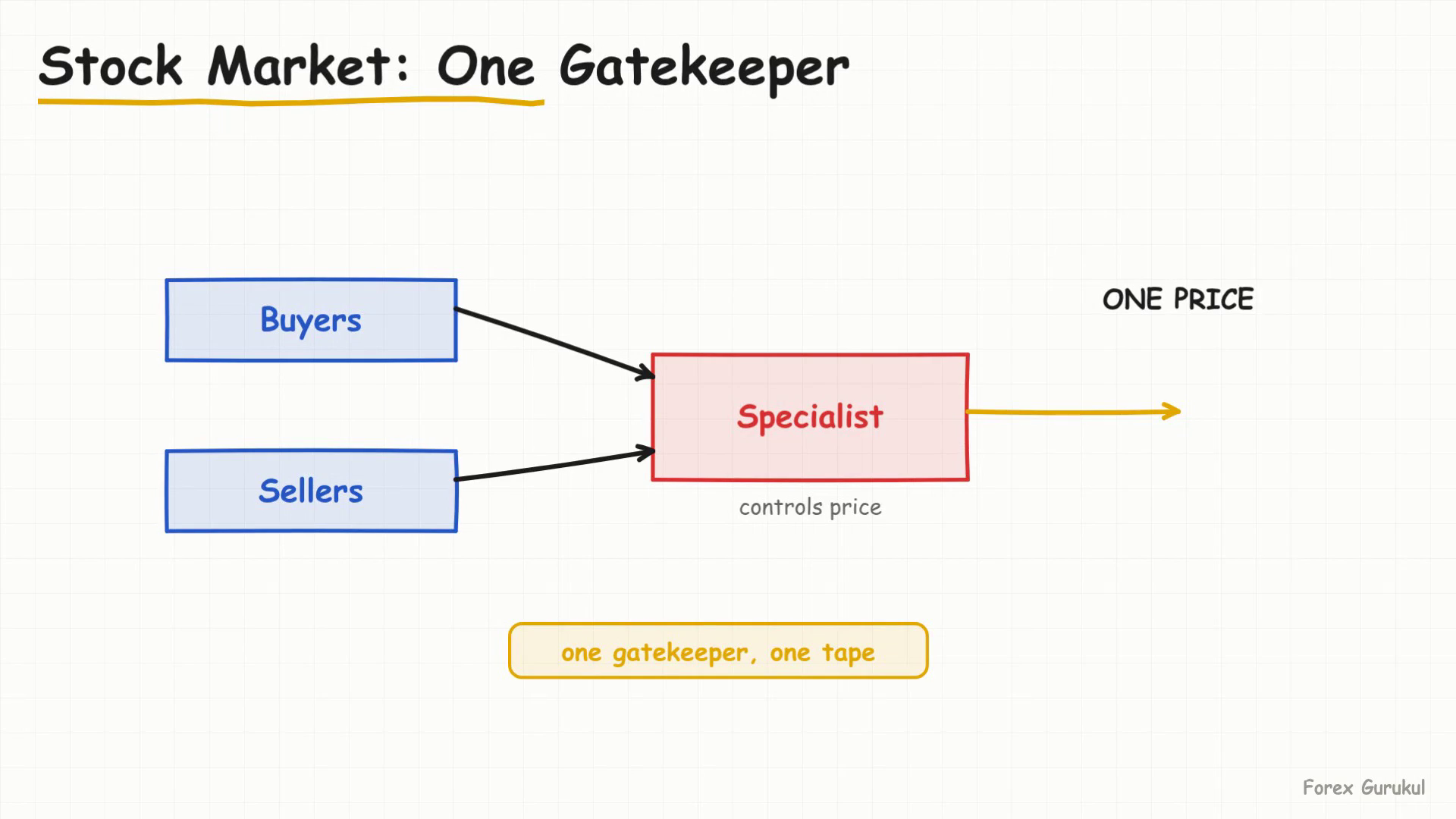
That desk also carries real power. If far more people want to buy than sell, the specialist can widen the gap between the buy price and the sell price, or nudge the quote itself, just to manage the imbalance. One person, one screen, one price everyone sees. Simple, centralized — and it works fine for stocks.
The Spread Can Move — And That's the Warning
Picture that specialist's control room for a second. When buyers are piling in and sellers are scarce, the desk doesn't just sit there. The spread — the gap between the price you can buy at and the price you can sell at — gets wider. That wider gap is the specialist quietly protecting the desk while the imbalance sorts itself out.
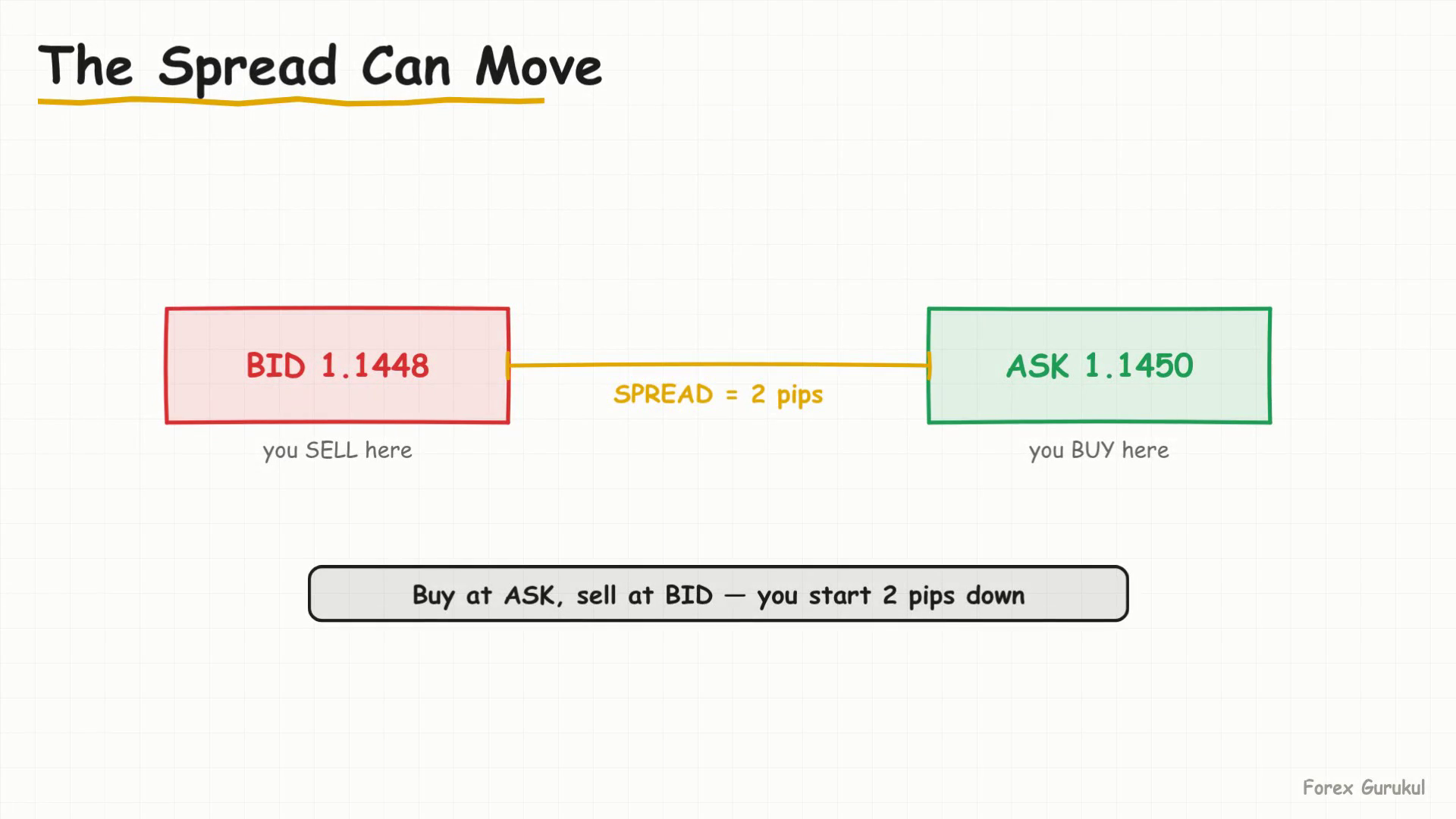
It isn't illegal — it's built into the job. But it means the price you see can shift because of order flow on that one desk, not just because of news or economics. That's the real problem with a single gatekeeper: they can lean on the spread whenever it suits them.
Hold that thought, because forex was built to remove exactly this kind of concentrated control. No single desk, no single spread to lean on. But removing the gatekeeper creates its own puzzle.
No Single Price In Forex — Killing the Ticker Myth
Here's a myth worth killing right now: people assume forex has an official price sitting somewhere, like a ticker on a wall in New York. It doesn't. Spot forex trades over the counter (OTC) — across a global web of dealers and banks, with no central exchange sitting in the middle.
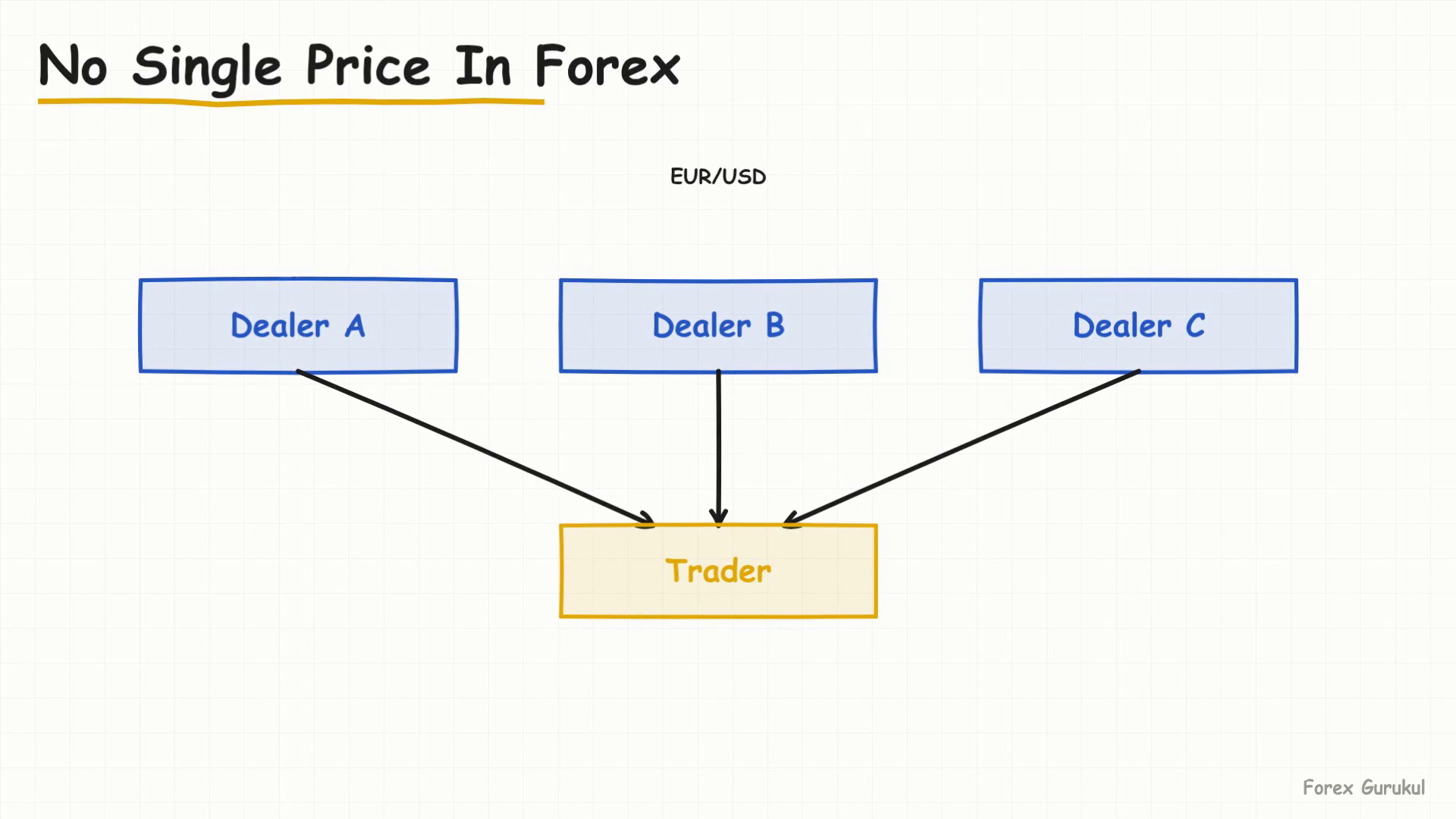
Every dealer quotes their own bid and ask based on their own supply, demand, and risk appetite. That's why Sam's price and his buddy's price were a few pips apart — they simply weren't looking at the same source, because there is no single source to look at.
But if every dealer quotes differently, how does the whole market avoid turning into chaos? That's where the ladder comes in.
The FX Ladder: From Big Banks to Your Phone
This is the single most useful picture in this entire topic. Quotes flow down a ladder, and every tier marks the price up slightly for the service of access.
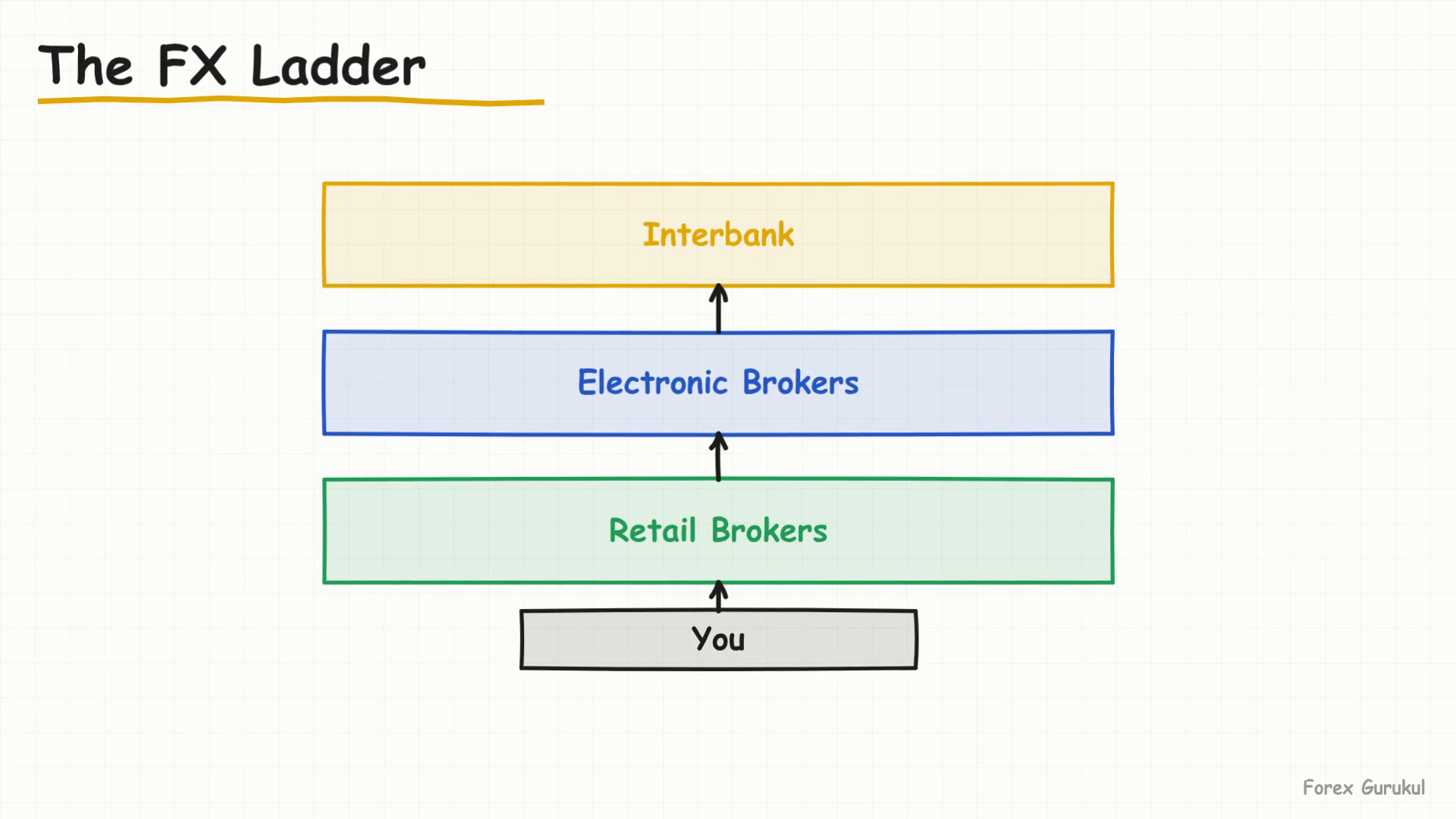
| Tier | Who's There | What Happens |
|---|---|---|
| Top — Interbank | Largest global banks | Trade enormous size directly or via electronic broking networks |
| Middle — Brokers & Liquidity Providers | Prime brokers, ECNs, market makers | Package interbank prices, add a small markup for access and risk |
| Bottom — Retail | You, Sam, your buddy's app | Trade the packaged price through an online broker platform |
Here's a pause-and-guess moment: which tier are you standing on when you click buy in your app? If you said the bottom rung, you're right — and that's completely fine, everyone starts there. But notice this: which tier you're on matters more than the number on your screen. Context beats the price every single time.
How The Reference Price Is Actually Made
So how does a price even get made at the top of that ladder? Big banks stream their buy and sell quotes into major electronic broking platforms — the interbank world's plumbing. Those platforms aggregate all the competing bank quotes and spit out a reference price, the number the rest of the ladder is built from.
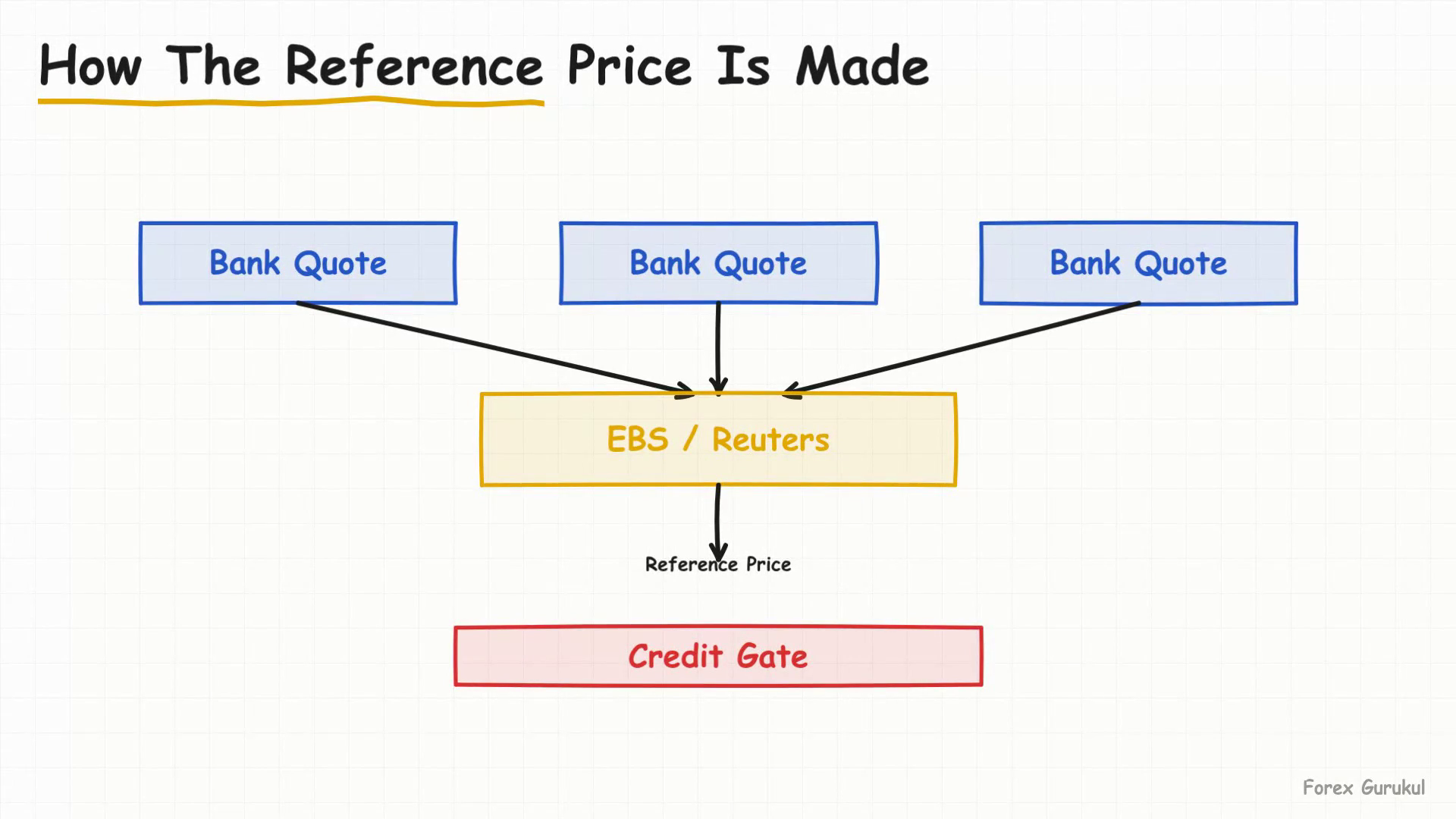
Here's the catch almost nobody outside a trading desk knows about: you cannot just log in and trade at that reference price. Access depends entirely on established credit relationships. A bank only trades with another bank, or lets a broker plug in, if a credit line already exists between them. No credit, no seat at that table — no matter how much cash you have.
Down at the bottom rung, none of that credit gatekeeping applies to you, and that's exactly why retail forex exploded. The internet and electronic trading knocked the barrier to entry down to almost nothing. Open an account, fund it with a few hundred dollars, and you're plugged into the same currency pair the big banks trade — just through a broker sitting a few tiers above you.
Sam Takes The Trade
The tool that makes a small account matter is leverage — controlling a much bigger position than your actual cash would normally allow. Say Sam sees EUR/USD coiling tight under a recent high, and it finally pushes through on rising momentum. About as simple as setups get: bullish continuation, nothing exotic.
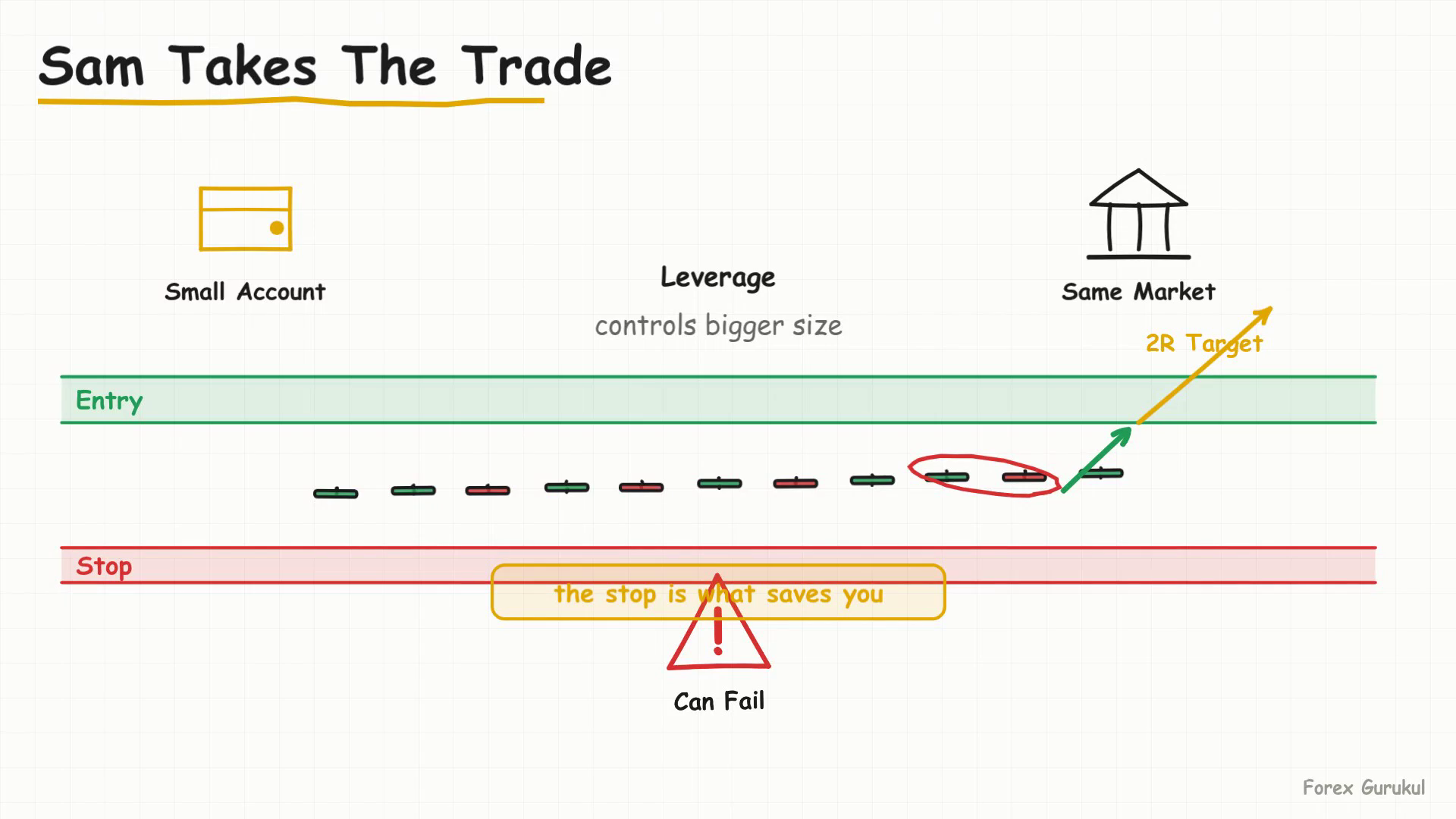
| Element | Rule | Purpose |
|---|---|---|
| Entry trigger | Breakout candle closes above range high | Confirms momentum before committing |
| Stop loss | Just below the range low, with wiggle room | Protects against normal noise shaking him out early |
| Target | 2x the risk (2:1 reward-to-risk) | Keeps the payoff worth the risk taken |
Leverage is what lets his small account actually matter here — but leverage cuts both directions, and this setup can still fail. That stop is there for a reason: no structure, no ladder tier, and no amount of leverage removes the need for a defined exit.
Euro / Dollar Live: Seeing the Ladder in Real Time
As of early August 2026, EUR/USD is trading around 1.1545–1.1550, holding steady near recent highs after closing out July on firmer footing Yahoo Finance. TradingView's live feed shows the pair around 1.1540, down a fraction on the day, a normal reflection of which liquidity source is being aggregated at that exact millisecond TradingView.
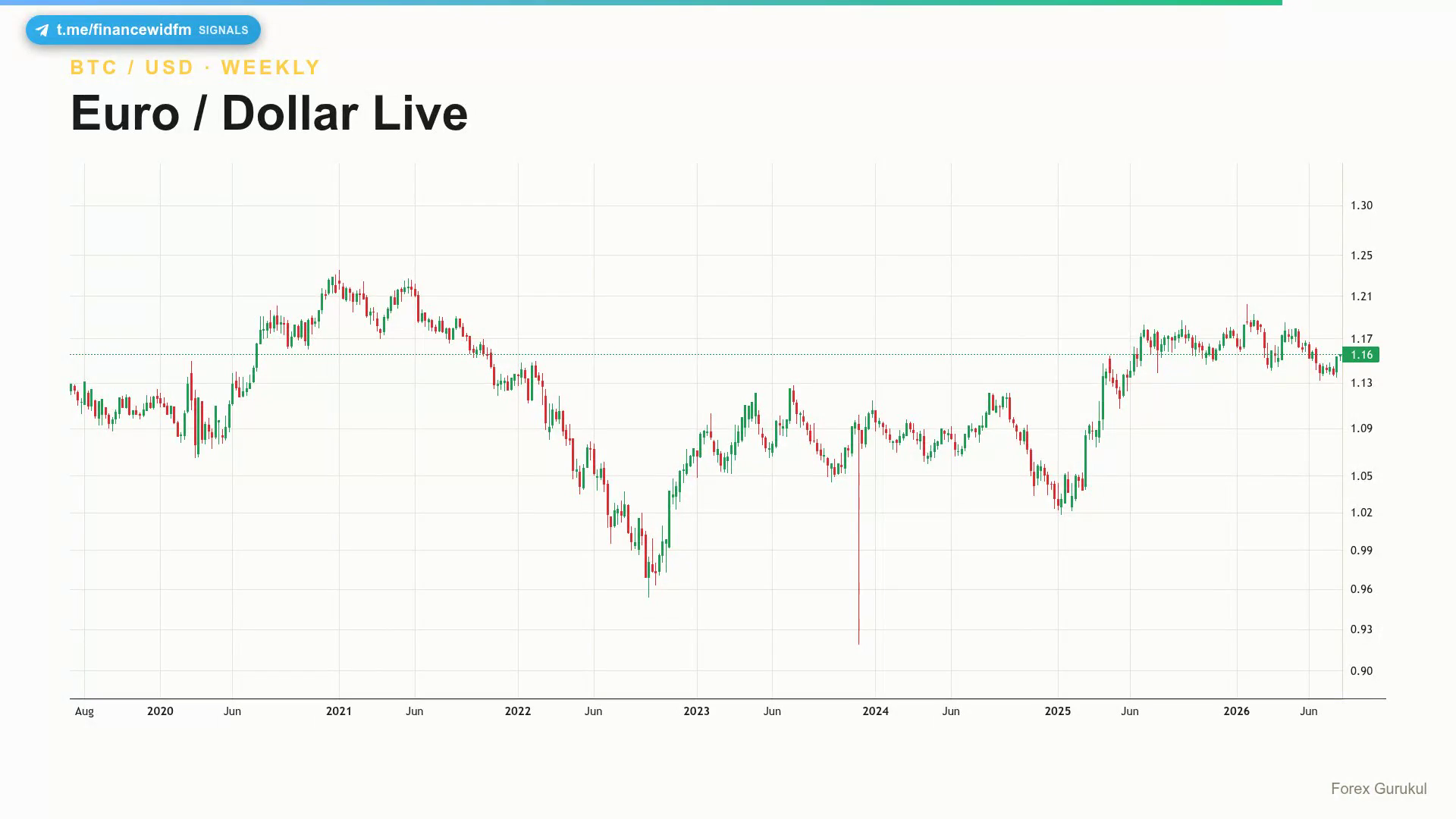
FXStreet's analysis desk has the pair holding ground near 1.1550 in early European hours, with a mild upside cap toward 1.1565 FXStreet. Forex.com describes EUR/USD as simply the exchange rate ticker showing how many US dollars are needed to buy one euro — the plumbing behind the number, not the number itself Forex.com.
This is exactly the phenomenon Sam and his buddy ran into on the couch. Every one of these numbers is legitimate. They come from different aggregation points on the same ladder, at slightly different microseconds, with slightly different liquidity pools feeding them.
Recap: The FX Ladder in One Picture
Let's bring it all together. Forex has no single gatekeeper, no central exchange, and no one official price — and that's not a flaw, it's the structural feature that keeps dealers competing for your business.
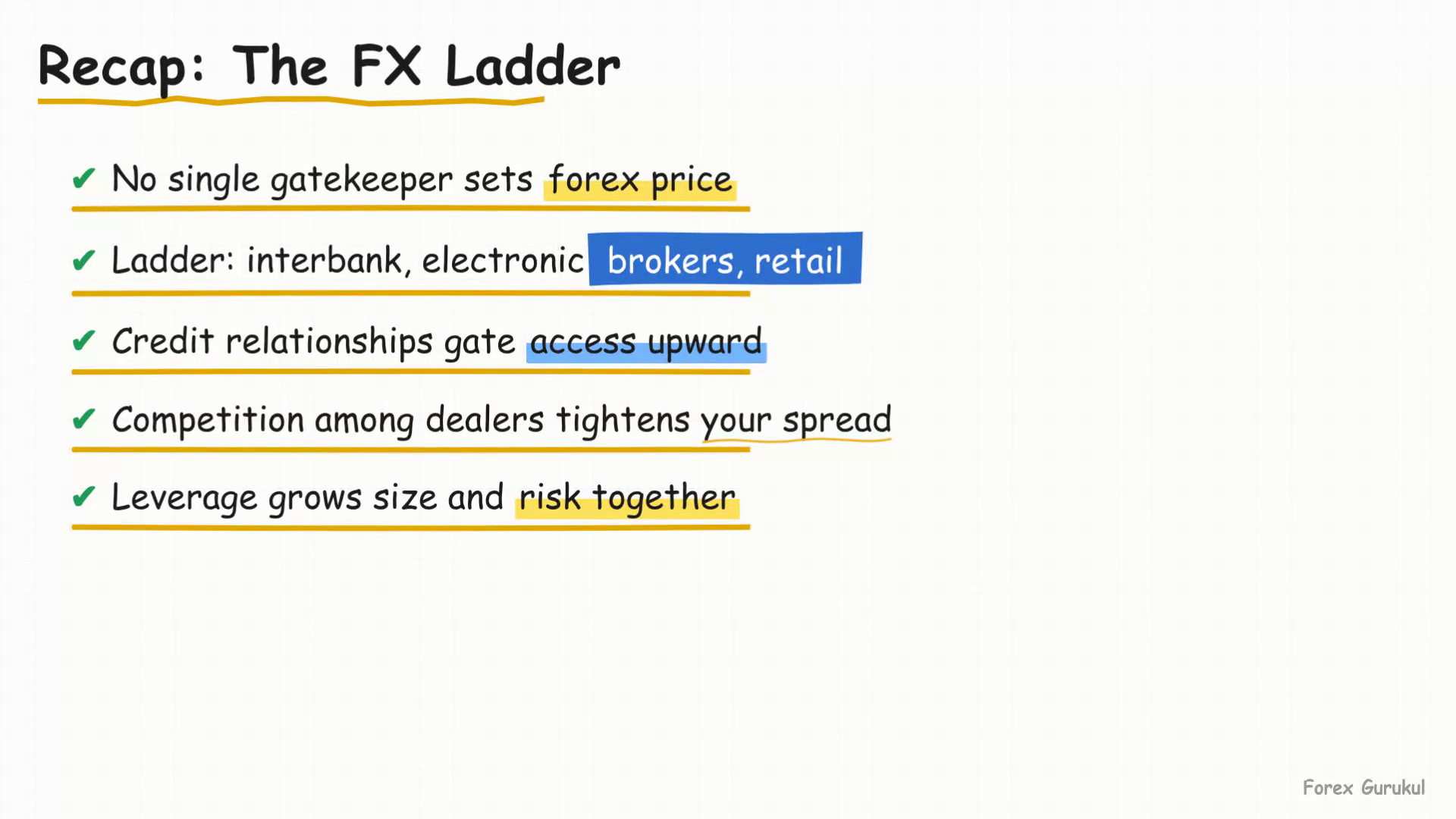
- Stocks run through a single gatekeeper who can widen spreads at will — forex was built without one.
- Spot FX trades over the counter across a global dealer network, so no two brokers are pulling from the identical source.
- The FX ladder runs from interbank, through brokers and liquidity providers, down to your retail app — each tier adding a small markup for access.
- Reference prices form at the top via bank-to-bank credit relationships you and I will never directly access.
- Leverage lets a small retail account participate meaningfully — but it amplifies both the win and the stop-loss outcome equally.
Next time your price and your friend's price don't match to the pip, you'll know exactly why — and you'll know it has nothing to do with either broker cheating you.
Key takeaways
- Forex has no central exchange or single official price — it trades over the counter across a global dealer network.
- The FX ladder runs from interbank banks, through brokers and liquidity providers, down to retail traders, with each tier adding a small markup.
- Reference prices form at the top of the ladder through bank credit relationships that retail traders never directly access.
- Small pip differences between brokers reflect which liquidity source is feeding each quote — not manipulation.
- Leverage lets small retail accounts trade meaningful size, but it magnifies both gains and losses equally.
Frequently asked questions
Why do two forex brokers show different prices for the same pair?
Because forex is over the counter with no central exchange, each broker aggregates quotes from its own liquidity providers on the FX ladder, producing small, normal pip differences.
Is one broker's price more 'correct' than another's?
No. Without a central exchange, there's no single official price. Both quotes are legitimate reflections of different points on the same ladder.
What is the FX ladder?
It's the tiered structure of the forex market: interbank banks at the top, brokers and liquidity providers in the middle, and retail traders at the bottom, with price and markup flowing downward.
Why can't retail traders access the interbank reference price directly?
Interbank trading requires established credit relationships between banks. Without a credit line, there's no direct seat at that table, regardless of account size.
Does a wider spread mean my broker is cheating me?
Not necessarily. Spreads widen naturally during order imbalances or volatility, similar to how a stock market gatekeeper protects their desk — it's a normal market mechanism, not automatically foul play.