
Lessons
Forex Session Overlaps: Why 70% of Volume Trades Here
The 2 A.M. Chart That Taught Dave a Lesson
It's two a.m. in New York, and Dave is staring at a EUR/USD chart that hasn't moved eight pips in the last hour. He read that forex trades twenty-four hours a day, so he figured any hour was a good hour. Two hours later, without changing a single input on his strategy, the same pair rips forty pips in twenty minutes. Dave didn't get smarter. The clock changed.
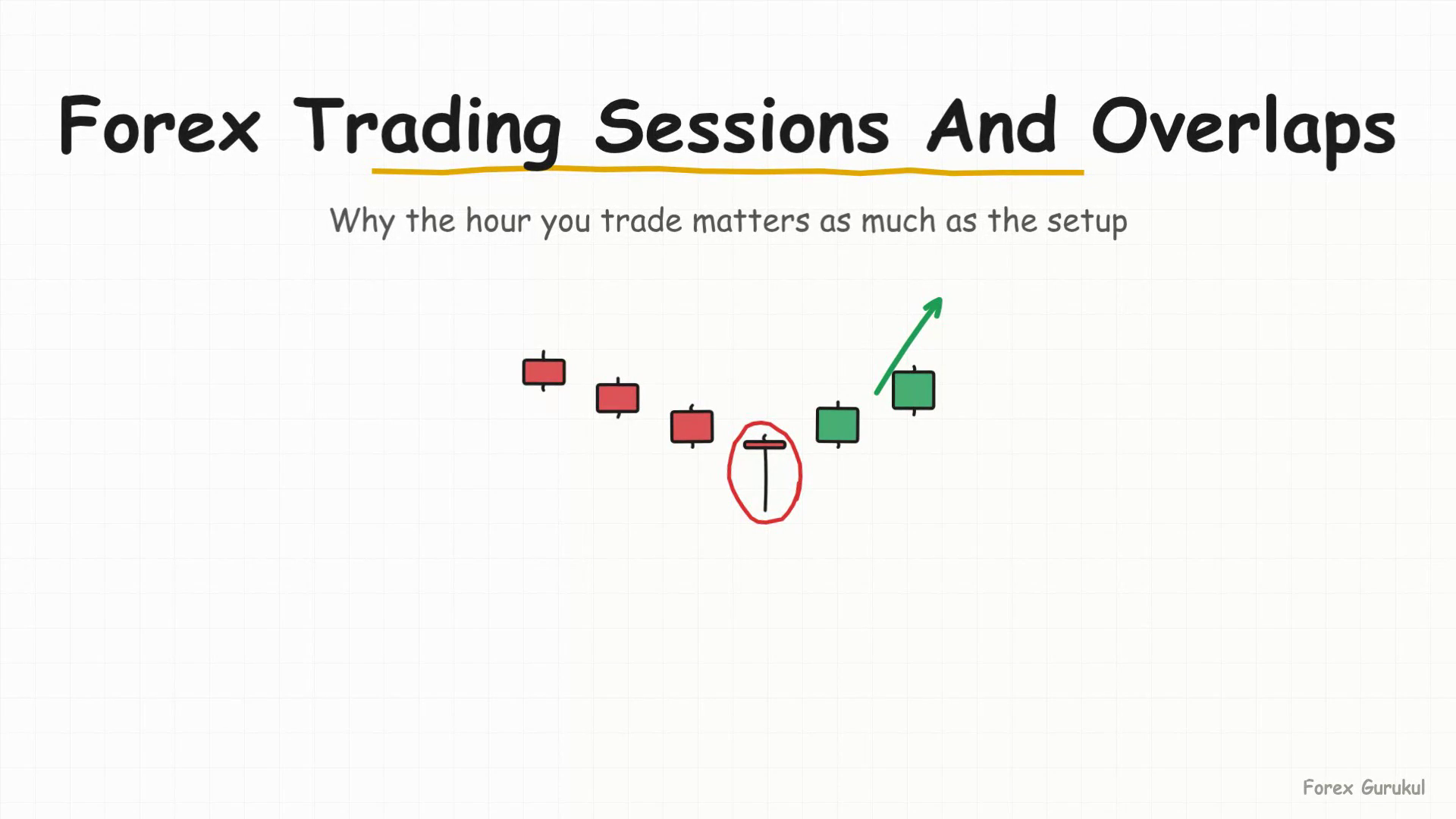
That flip from dead-quiet to fast-and-loud is the whole story of this article. We're taking apart exactly why the hour you trade forex in matters as much as the setup you trade, starting with the overlap that was quietly running in the background the whole time Dave was watching his flat chart.
The 24-Hour Trading Clock: How Sessions Hand Off
Forex never closes Monday through Friday. Tokyo hands off to London, London hands off to New York, and New York hands back to Tokyo to start the loop again. That's the marketing version everyone learns first, and it's true — the market is technically open around the clock (Investopedia breaks the three-session structure down clearly).
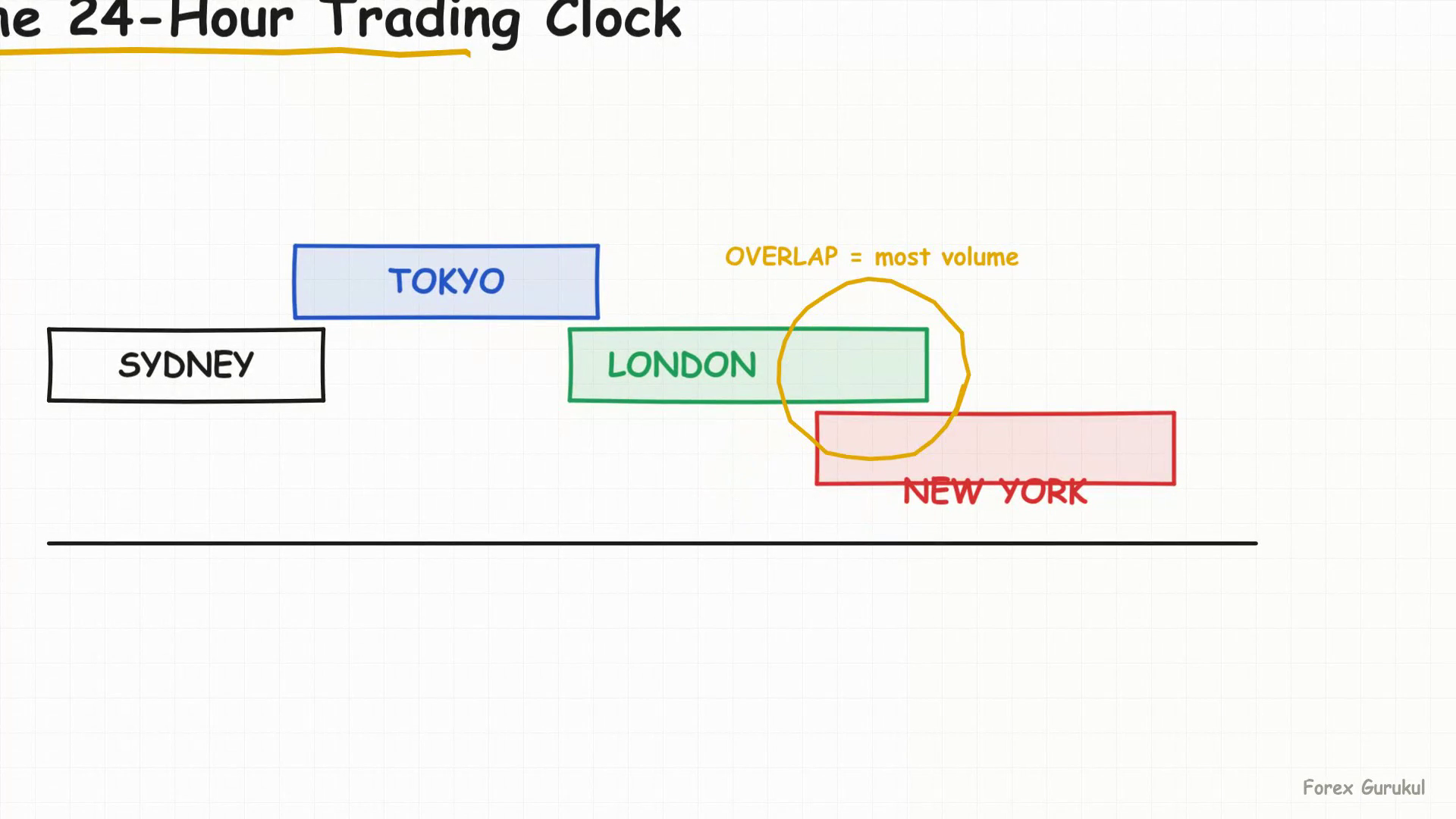
But the market isn't equally alive the whole time. Liquidity — how many buyers and sellers are actually standing at the table — swells and shrinks depending on which cities are awake at the same moment. Dave's two a.m. candle was quiet because only a thin slice of Asian desks were even online at that point in the New York night.
The real question isn't whether the market is open. It's whether anyone with size is actually in the room, and that only happens when sessions overlap.
| Session | Approx. Hours (GMT) | Character |
|---|---|---|
| Tokyo (Asian) | 23:00 - 08:00 | Steady but thin, dominated by JPY and AUD pairs |
| London (European) | 07:00 - 16:00 | Highest single-session volume, sets the day's tone |
| New York (American) | 12:00 - 21:00 | Volatile open, driven by USD data and equity flows |
Two Overlaps on the Clock: Not All Overlaps Are Equal
There are two moments each day where two major sessions run at once. Early in the Tokyo day, London traders start arriving for their morning, and for roughly one hour the two sessions sit side by side — thin, but not empty. Later, London is deep into its afternoon exactly when New York opens its doors, and for close to four hours both sessions are fully staffed at the same time.
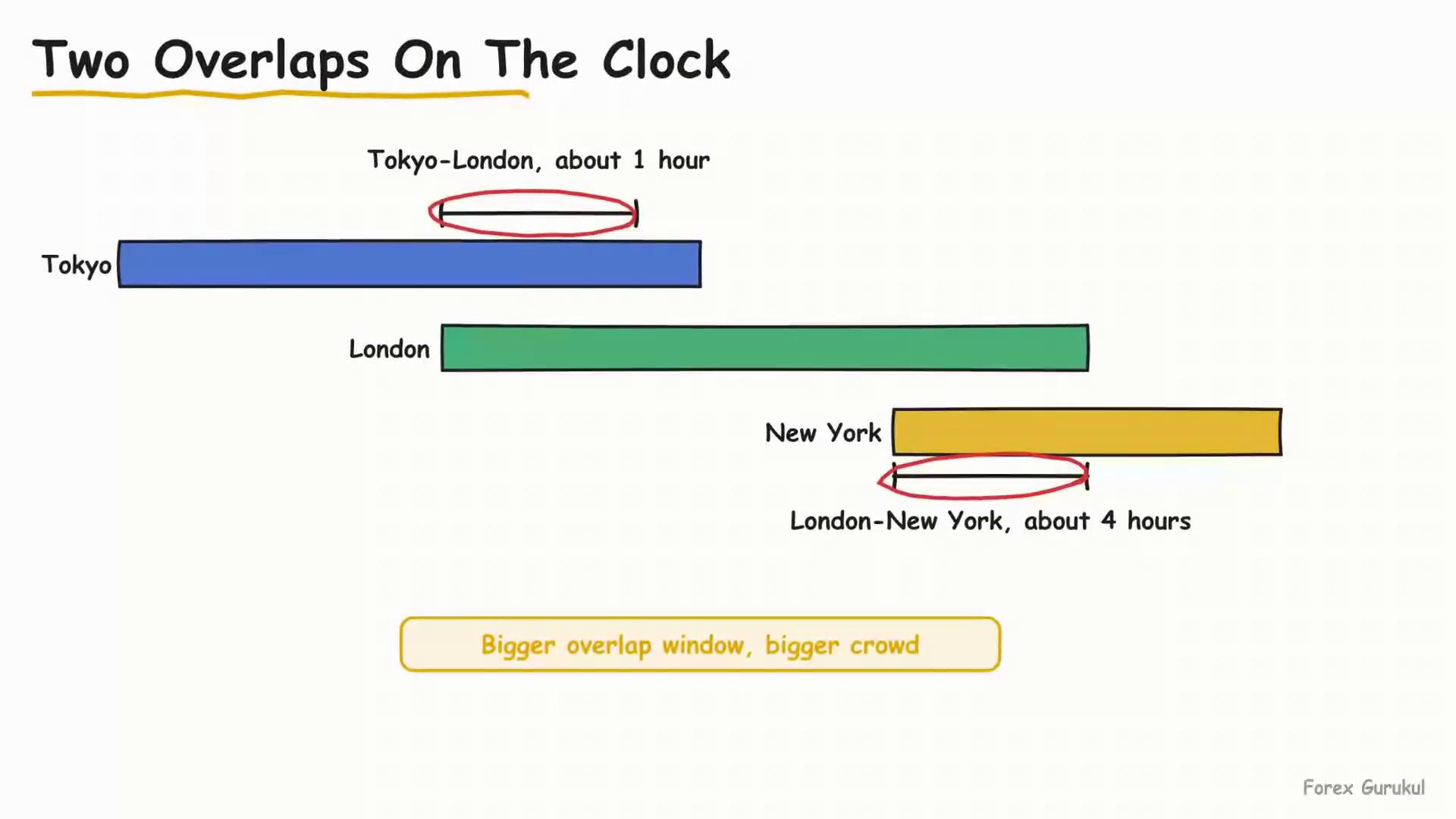
Same word, overlap, two very different rooms. One's a quiet handshake. The other's rush hour. Which one do you think moved Dave's chart at four a.m. New York time, and which one was still asleep?
| Overlap | Approx. Window (GMT) | Duration | Typical Feel |
|---|---|---|---|
| Tokyo - London | 07:00 - 08:00 | ~1 hour | Modest pickup, low-volatility transition |
| London - New York | 13:00 - 17:00 | ~4 hours | Peak volume, sharpest moves, tightest spreads |
Dukascopy's market-hours desk and Myfxbook's session tool both flag the same window — roughly 13:00 to 16:00-17:00 GMT — as the period traders consistently label the most active stretch of the trading day.
Liquidity and Volume Face-Off: The Numbers Behind the Noise
Here's the number that should reset how you think about this. The London-New York overlap alone can account for more than half of all forex volume traded that day, and on active days traders estimate it pushes past seventy percent. One trading-hours breakdown puts the figure squarely in that range, noting the overlap captures roughly 60-70% of daily trading volume in just four hours — the single most important window in each 24-hour cycle.
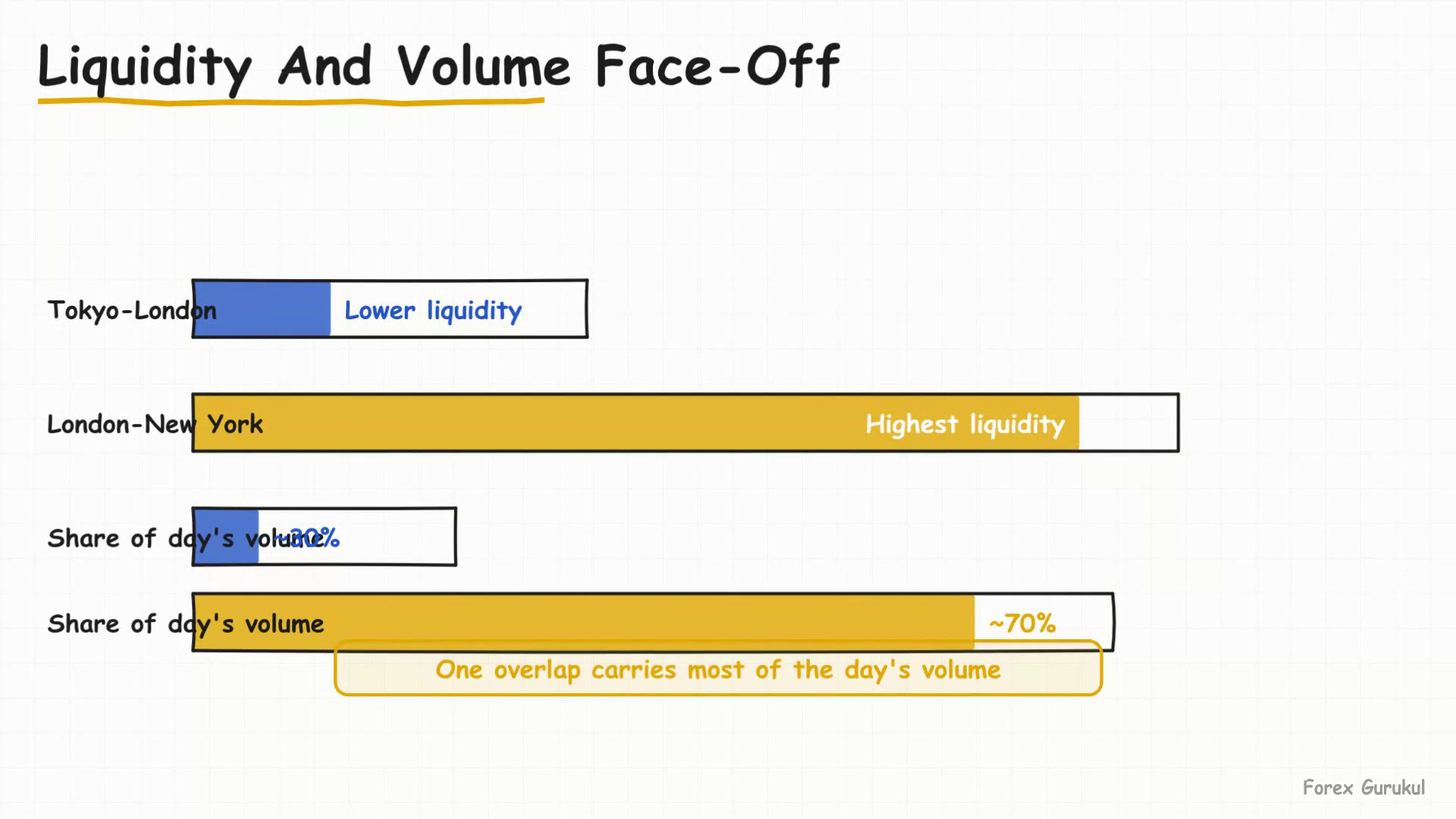
The Tokyo-London overlap, by comparison, is a trickle next to that. More desks open at once means more resting orders, more competing quotes, and more size clearing at every price. That's liquidity, and liquidity is the actual engine under everything we're about to cover — not the clock, the crowd.
| Metric | Tokyo-London Overlap | London-New York Overlap |
|---|---|---|
| Session duration | ~1 hour | ~4 hours |
| Estimated share of daily FX volume | Low single digits | 50-70% |
| Typical spread behavior | Slightly tighter than Asia alone | Tightest of the day on majors |
| Best-suited pairs | USD/JPY, AUD/USD | EUR/USD, GBP/USD, USD/JPY |
Quiet Hours vs. Loud Hours: What Price Actually Does
Watch what that crowd does to price. During the quiet Tokyo stretch, candles stay small and ranges stay tight — there simply isn't enough disagreement in the room to push price far. The moment London overlaps New York's afternoon, candles stretch out, wicks get longer, and moves that took six hours overnight can happen in twenty minutes.
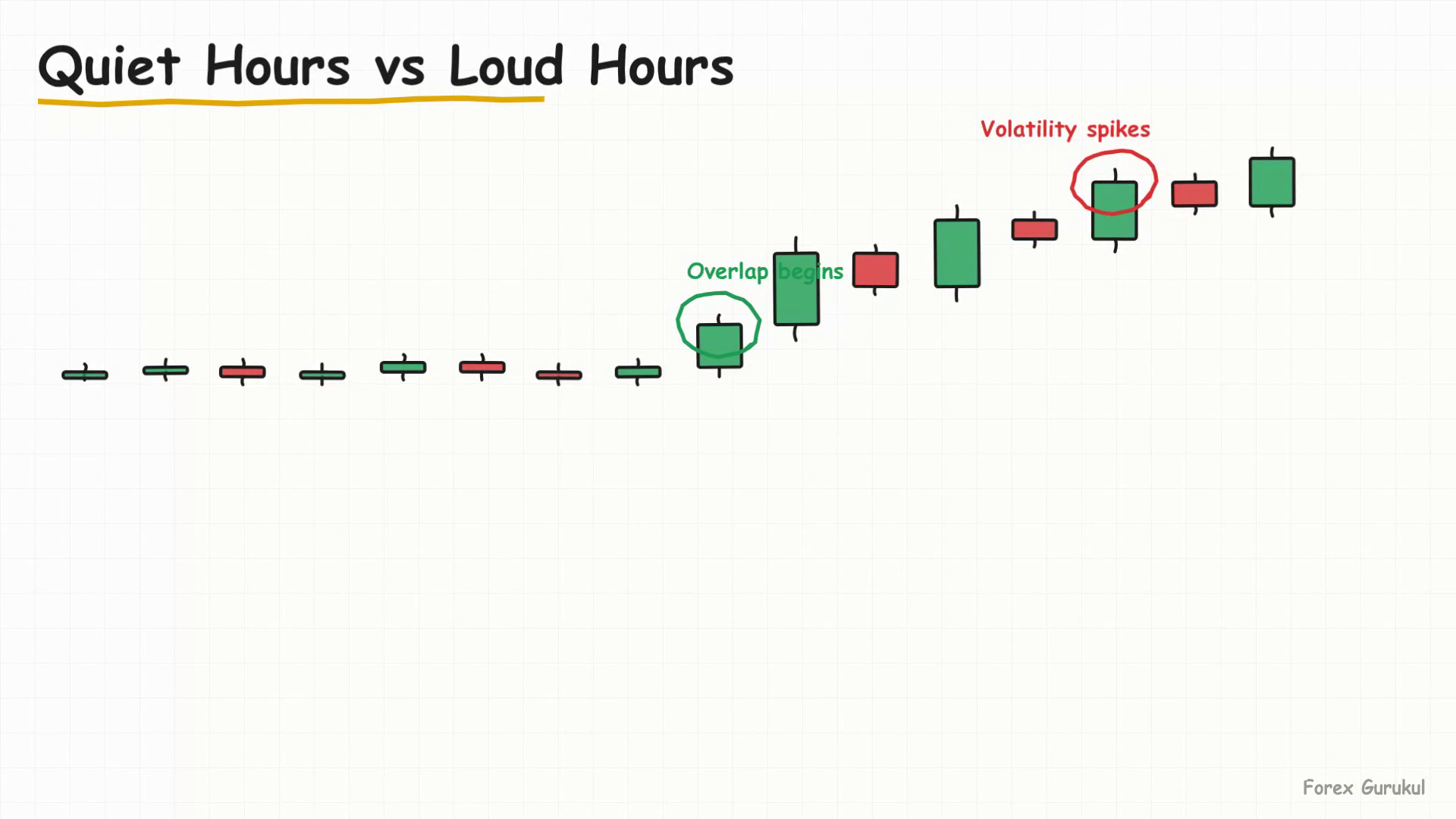
This isn't randomness — it's supply and demand getting crowded much faster. When two major financial centers are trading the same currency at the same time, price discovery accelerates because far more orders are competing to be filled at once.
- Quiet hours (late Tokyo / pre-London): smaller ranges, choppier price action, wider effective spreads on some brokers
- Loud hours (London-New York overlap): larger ranges, cleaner trends, tighter spreads on major pairs
- Transition hours (session open/close): can spike briefly, then settle — watch for false breakouts near the handoff
Pause for a second and guess: if Dave had waited those two extra hours instead of trading at two a.m., would his stop have gotten hit, or would his target have?
Remember: Context Beats the Pattern
Every setup you've ever learned — a breakout, a pullback, a reversal candle — behaves differently depending on which session stamped it. The same pattern that fails quietly during a thin Asian session can play out cleanly during the London-New York overlap, simply because there's enough participation behind it to follow through.
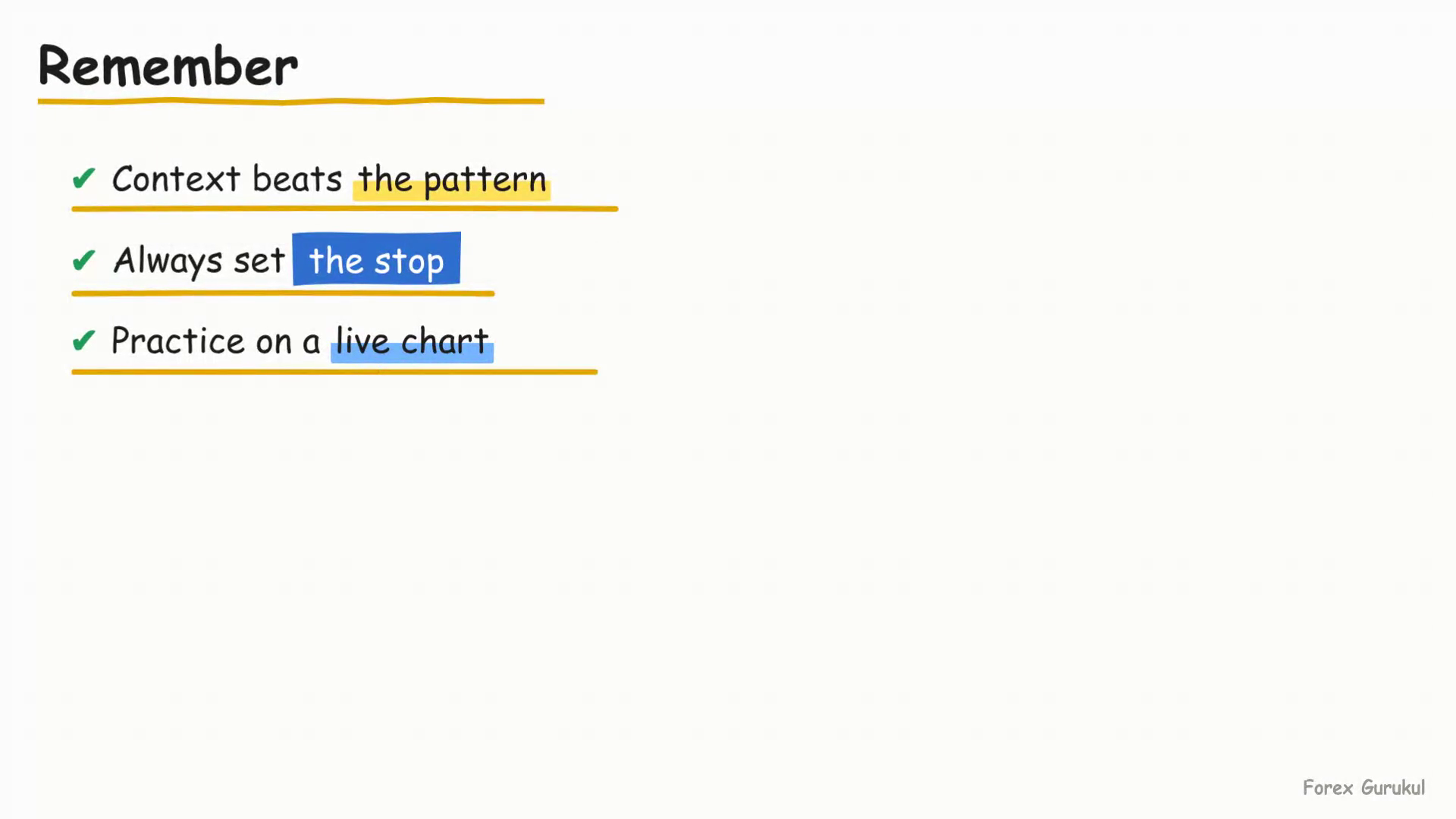
Context beats the pattern. The stop is what saves you. And nothing replaces practice on a live chart, watching how your specific pairs behave as sessions stack and unstack in real time.
- Know the overlap windows for your pairs before you place a trade, not after
- Treat the London-New York overlap as the market's rush hour — size and manage risk accordingly
- Use quieter hours for planning and analysis, not for chasing breakouts
- Always trade with a stop — liquidity cuts both ways, and fast markets punish unprotected positions fastest
Key takeaways
- Forex trades 24 hours a day, but liquidity is concentrated in specific windows — not spread evenly across the clock
- The London-New York overlap (roughly 13:00-17:00 GMT) can drive 50-70% of daily forex volume in about four hours
- The Tokyo-London overlap is real but far smaller — a brief handshake compared to the London-New York rush hour
- More participants trading at once means tighter spreads, faster fills, and bigger price moves — for better or worse
- The same strategy can perform very differently depending on which session it's traded in — context matters as much as the setup
Frequently asked questions
What time is the London-New York forex overlap?
It runs roughly from 13:00 to 17:00 GMT (8 a.m. to noon Eastern Time), when the London afternoon overlaps New York's morning open.
Why does the London-New York overlap have so much volume?
Two of the world's largest financial centers are trading simultaneously, so far more institutional and retail orders compete for the same prices at once, concentrating liquidity into that window.
Is the Tokyo-London overlap worth trading?
It's usable but modest — activity picks up slightly compared to the quiet Asian hours, but nowhere near the volume or volatility seen in the London-New York overlap.
Does higher volume mean higher risk?
It means faster, bigger moves in both directions. Spreads are usually tighter, but price can travel further in less time, so stop-loss discipline matters more, not less.
Which pairs benefit most from the London-New York overlap?
EUR/USD, GBP/USD, and USD/JPY typically see the sharpest increase in volume and range during this window, since they're the most actively quoted pairs across both sessions.