
News
Top 15 Crypto News Today: Fear Grips Market, BTC Holds $65K
Crypto Sentiment Turns Fearful: What's Driving the Pullback
Crypto markets woke up on August 8, 2026 in a noticeably cautious mood. The Fear and Greed Index is sitting around 39 out of 100, a sharp drop from the extreme-greed readings that dominated headlines earlier this year. Sentiment trackers built from volatility, momentum, social volume, and dominance data all point the same direction: risk appetite is cooling fast.
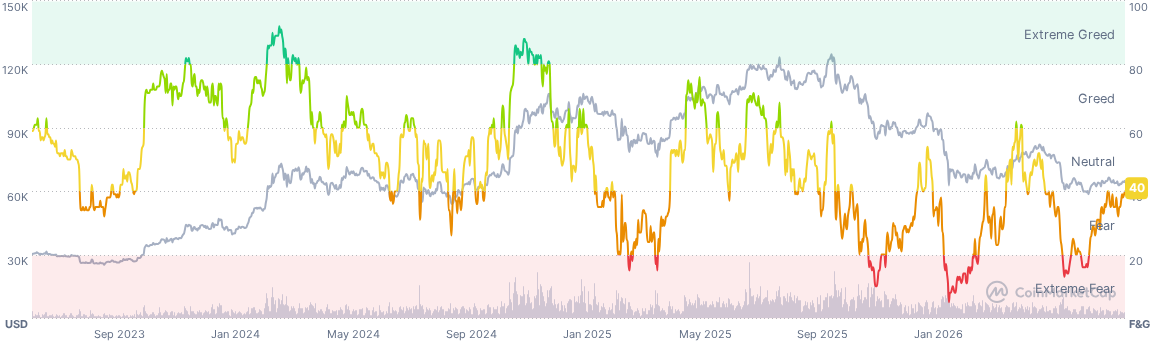
Total crypto market capitalization is holding near $2.2 trillion, roughly flat on the day, while Bitcoin dominance remains strong at almost 59%. That combination — flat total cap, rising dominance — is the classic signature of a market rotating out of speculative altcoins and into perceived safety.
Bitcoin Price Check: Holding $65K, But Flows Are Still Mixed
Bitcoin is consolidating just above the psychologically important $65,000 level. Short-term flow data — the kind that tracks exchange inflows and outflows over a 24-to-48-hour window — is finally turning friendlier for buyers. But zoom out to a longer time frame and spot flows still show sellers firmly in control of the broader trend.
| Metric | Reading |
|---|---|
| Bitcoin Price | ~$65,000 |
| Total Crypto Market Cap | ~$2.2 trillion |
| Bitcoin Dominance | ~59% |
| Fear & Greed Index | 39 (Fear) |
| Short-Term Flows | Turning positive |
| Long-Term Spot Flows | Still net negative |
This tug-of-war between short-term buying and longer-term distribution is exactly the kind of setup that keeps traders on edge — and it connects directly to the bigger structural risk we cover later in this roundup around BIP-110 coins.
Institutional and AI Money Keeps Reshuffling the Board
Away from spot charts, the bigger story today is how fast traditional finance and AI infrastructure money are colliding. JPMorgan now estimates technology companies could sell more than $500 billion in bonds during 2026 alone, a surge that risks squeezing credit spreads across an already crowded investment-grade market.
| Story | Key Number |
|---|---|
| JPMorgan tech bond forecast | $500B+ in 2026 issuance |
| Goldman Sachs stake in Nebius Group | 7.2% passive stake |
| Nvidia's potential Lancium stake | Up to 30%, ~$1B investment |
| Switch IPO valuation target | ~$80 billion |
Goldman Sachs disclosed a 7.2% passive stake in Nebius Group — the AI infrastructure company formerly known as Yandex — a filing that signals big institutional money is quietly building AI exposure through unconventional channels. Nvidia, meanwhile, is reportedly weighing a $1 billion investment that could push its stake in energy firm Lancium as high as 30%, the clearest sign yet that chipmakers are racing to lock down the power supply AI needs to keep scaling.
Data center operator Switch has confidentially filed for a US IPO, chasing a valuation near $80 billion on the back of the AI infrastructure boom. Investors are effectively racing to own the physical backbone of artificial intelligence before demand outpaces supply.
Regulatory Delays and Legal Shockwaves
On the policy front, the news isn't great for digital asset clarity. The Senate has left Washington for summer recess without passing the Crypto Clarity Act, leaving digital asset regulation stuck in limbo for months longer. Industry groups warn that every delay like this chips away at investor confidence heading into the next cycle.
- Crypto Clarity Act stalls — no Senate vote before recess
- Meta ruled a public nuisance in New Mexico, ordered to pay $942 million
- Lido publishes a post-mortem tracing its SRv3 bug to an oracle accounting oversight
Separately, a New Mexico judge has ruled Meta a public nuisance, ordering the company to pay $942 million over harm linked to its platforms — a ruling that could open the door to similar penalties against other tech giants down the line. In DeFi, Lido has published a transparent post-mortem on its Staking Router v3 incident, tracing the bug to an oversight in the accounting oracle. Publishing the root cause this openly is a clear attempt to rebuild trust with anyone staking through the protocol.
The Chip Crunch Is Hitting the Real Economy
It's not just semiconductor makers feeling the squeeze anymore. Japanese chemical maker Ajinomoto has raised prices by 30%, blaming a tightening AI chip supply chain that is squeezing its own production costs. When a supplier this far up the chain hikes prices that hard, it's a signal of just how strained global chip production has become.

Geopolitical Flashpoints: Hormuz Tensions and China's Data Play
Energy giant ADNOC has reported 15 vessel attacks as tensions spike sharply near the Strait of Hormuz, and Yemen's military has now launched its own operation after Houthi attacks escalated the conflict further. Together, these clashes raise real fears of a wider disruption to global oil and shipping routes — the kind of shock that historically sends risk assets, crypto included, lower in a hurry.

In a quieter but arguably longer-lasting development, China has unveiled a massive plan to build out its own AI training datasets as a global data shortage looms over the industry. It's a clear play for technological independence at a moment when data itself has become a geopolitical weapon — and one worth watching for how it eventually reshapes crypto and AI infrastructure narratives.
Shiba Inu's Huge Outflow vs. Australian Miners' Best Week Since 2024
Shiba Inu just recorded 522 billion tokens in outflows over 24 hours. On-chain watchers say any hope of a quick recovery is effectively cancelled after a dump that size — exit pressure like this usually front-runs a sharper move lower for the token.
| Asset/Market | Data Point |
|---|---|
| SHIB 24h outflows | 522 billion tokens |
| Australian mining stocks | Best weekly gain since 2024 |
| Driver | Rally in copper and gold prices |
On the flip side, Australian mining stocks just posted their biggest weekly gain since 2024, fueled by a rally in copper and gold prices. Higher commodity prices are boosting earnings expectations and could ripple into broader global market sentiment — a reminder that not every corner of the market is in retreat today.
The Hidden Risk: Selling BIP-110 Coins Could Cost You Real Bitcoin
This is the story that ties the whole list together. A developer is warning that Bitcoin holders could lose real Bitcoin if they sell coins originating from the BIP-110 fork without understanding the underlying mechanics. Because certain fork-derived coins share transaction formats with mainnet BTC, careless selling or wallet handling can inadvertently move or expose genuine Bitcoin holdings alongside the fork asset.
This warning connects directly back to the longer-term spot flow weakness we flagged earlier for Bitcoin itself. Structural, technical risks like this one tend to compound seller pressure exactly when sentiment is already fragile — which is precisely where the market sits today, with the Fear and Greed Index reading 39 and dominance concentrating in BTC.
Key takeaways
- Fear and Greed Index has dropped to 39, with Bitcoin dominance near 59% as capital rotates toward safety.
- Bitcoin is consolidating near $65,000 with mixed flows — short-term buying vs. persistent long-term selling.
- AI infrastructure money is surging: Goldman's Nebius stake, Nvidia's potential Lancium deal, and a possible $80B Switch IPO.
- Geopolitical risk is rising fast near the Strait of Hormuz, while China doubles down on AI data sovereignty.
- A BIP-110 fork mechanic could quietly cost Bitcoin holders real BTC if fork-derived coins are sold carelessly.
Frequently asked questions
What is the Fear and Greed Index reading for crypto today?
As of August 8, 2026, the Crypto Fear and Greed Index reads around 39, placing the market in fear territory after a pullback from earlier extreme-greed levels.
Is Bitcoin still holding above $65,000?
Yes, Bitcoin is consolidating near $65,000, with short-term flows improving even as longer-term spot flows remain net negative.
What is the BIP-110 risk that could cost holders real Bitcoin?
Developers warn that fork-derived coins tied to BIP-110 can share transaction characteristics with mainnet BTC, meaning careless selling or wallet handling could inadvertently expose or move genuine Bitcoin holdings.
Why did Shiba Inu see such a large outflow?
SHIB recorded 522 billion tokens in 24-hour outflows, a move on-chain analysts say signals strong exit pressure and reduces the odds of a quick short-term recovery.
How are geopolitical tensions near Hormuz affecting markets?
Reported vessel attacks and escalating military action near the Strait of Hormuz are raising fears of disruption to global oil and shipping routes, a risk factor that can spill over into broader risk-asset sentiment including crypto.